Followers

Wednesday, February 4, 2009

Transport hit as UK wakes to heaviest snow in decades

Martin Wainwright

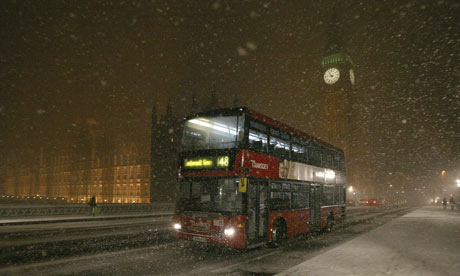
A bus goes past the House of Commons as it crosses Westminister Bridge during a snow fall

A bus goes past the House of Commons as it crosses Westminister Bridge during a snow fall in London Photograph: Andrew Parsons/Reuters

The heaviest snow for two decades moved into Britain on a freezing easterly wind last night after gathering strength over the North Sea. Falls of up to 10cm (4in) are predicted initially on the south-east coast and inland as far as London before the storms head north.

The Met Office said it was classifying today's expected snowfall as an "extreme weather event".

It was already causing chaos last night as trains were delayed and some airport runways temporarily closed. Gatwick and London City airports were both temporarily shut as their runways were de-iced, although City failed to reopen, as it closes ordinarily at 10pm. A Gatwick spokeswoman said that 23 flights had been cancelled and 18 diverted, although the runway reopened at 10pm.

A number of train services linking London and the south coast were also delayed or cancelled as snow drifted on to the tracks. And all London bus services were withdrawn, according to Transport for London's website.

High ground in Kent and Sussex could see as much as 20cm fall. "Severe disruption to roads and airports is extremely probable during the peak of the Monday afternoon rush hour," said Tom Defty, head of forecasting operations at MetService.

Blizzards and drifts may affect coastal areas and close scores of roads if high winds persist. The northbound M20 in Kent was closed last night between Ashford and Leeds castle after icy roads caused a series of minor collisions. There were no injuries. Forecasters predicted the gathering strength of the cold front would see heavy falls well inland and moving north, with 5cm predicted for Leeds and Bradford in Yorkshire.

Forecasters predict that the freeze will match conditions in the winter of 1991 when blizzards were followed by a prolonged period of temperatures well below freezing. Drifts up to three metres high closed roads and rail lines and shops saw a brief but marked drop in takings as fewer people ventured out.

The current snap is expected to thaw much sooner, with temperatures rising later this week, but further snow is forecast. Overall, the renewed cold spell is certain to seal this winter's dubious distinction of being the coldest for 13 years.

Gale force winds were recorded in several areas offshore as the snow moved towards the long curve of the Yorkshire and Lincolnshire coastline between Bridlington and Skegness.

People across the country were warned to avoid unnecessary journeys, with below-freezing temperatures dropping even further in many areas because of wind chill. The snow follows a relatively mild spell after the three-week freeze in early January which saw lows of -13C (8.6F). The previous coldest winter was in 1995 when -27.2C was recorded at Altnaharra in the northern Highlands.

Bookmakers have cut odds against 2009 being the coldest winter on record from 12-1 to 8-1 but a counter-trend is also seeing betting on a hot summer.

Rupert Adams of William Hill said: "Punters seem to be confidently optimistic about that and we have odds of as low as 6-1 on temperatures topping 100F."

Robert Hutchison of Ladbrokes said bets had started coming in that the Thames would freeze, with odds at 80-1. He said: "We're also seeing plenty of bets on a white Valentine's Day after the disappointment of missing out on snow at Christmas."

Original here

Iowa's green energy policy struggle

By Scott Simon
BBC News, Iowa

The presence of prairie winds and rich soil makes Iowa literally fertile ground for developing alternative energy sources from wind turbines and biofuels.

Iowa wind turbines (File picture)
Iowa invested $6m in wind turbine manufacturing

But the landscape is also a reminder that achieving energy independence is a formidable challenge and making an agricultural economy green is not easy.

Farm workers cannot take subways to work, farmers have to drive long distances into the fields to sow and harvest their crops and to deliver them to markets.

Farm animals themselves, not to put too fine a point on it, produce methane - a powerful greenhouse gas - that is trapped in the atmosphere.

Those challenges have not stopped the state setting itself ambitious goals.

Energy pioneers

The Iowa Climate Change Advisory Panel recently wrote a report for Governor Chet Culver setting out how the state can reduce carbon emissions by 90% by 2030.

The state has set up an Office of Energy Independence - surely the perfect place, I thought, to test how easy it will be for President Obama to achieve energy independence for the whole of America.

There are plenty of energy pioneers to be found in Iowa.

I feel like I'm doing something more than just building a washing machine, I'm building something for everyone to capitalise on
Crugar Tuttle
Wind turbine factory worker

Roger Neuberger, a farmer, lives near Clear Lake in the north-west part of the State - where the wind blows hardest.

He gets money from an energy company each year for making room for two wind turbines on his land.

Mr Neuberger has promised the energy company that he will not publicly reveal how much he is being paid, but other farmers have let it be known that, depending on when their contracts were signed, they can receive somewhere between $2,000 (£1,400) and $4,000 per turbine every year for the next 30 years.

Mr Neuberger is very happy, if rather modest about his role at the new frontier.

Asked if he felt like a pioneer, he replied: "Yeah, I suppose so."

"There were a number of farmers who didn't want to do this because they didn't understand - they were concerned how they were going to be treated. We've been treated wonderful. I couldn't ask for anything better."

Foreign oil

Iowa hopes that wind energy will deliver more than just electricity - and that investment in wind technology will help to transform towns depressed by unemployment.

Towns like Newton, which is just to the east of the capital, Des Moines.

Nearly 2,000 people lost their jobs in Newton when the town's biggest employer, Whirlpool, shut its doors in 2007.

Ethanol processing plant
Is ethanol really a clean alternative to fossil fuels?
Hundreds of those same workers, who once made washing machine parts, now make blades for wind turbines at the TPI factory.

But the jobs did not come cheap.

The state gave the manufacturer $6m in subsidies and tax breaks - in return the company promised to hire 500 people.

Larry Crady worked at Whirlpool for 23 years, making coin-operated laundry machines.

"It just wows you when you see a blade open and close," Larry says. "When you pull that blade out of the mould it's exciting, I feel like I'm doing something more than just building a washing machine, I'm building something for everyone to capitalise on."

Mr Crady's sense of wonder is understandable - the plant certainly has the "wow" factor.

The turbine blades are as long as a 747 jet and the factory is longer than an aircraft carrier.

It is fitting, then, that - according to the plant's manager - so many of those that work there feel that making the blades is as much about national security as it is about electricity.

"A lot of us in this company and in wind energy have a sense of calling to this," Crugar Tuttle says. "I think in the interview process it comes out with a lot of our veterans that this is about weaning us off foreign oil."

But wind energy is a long way from delivering independence for Iowa any time soon.

It provides just 8% of Iowa's energy needs.

If it is to go any way towards making the rest of the country energy independent, a distribution grid would be needed.

Controversial

President Obama has promised to invest $150bn in renewable energy over the next 10 years.

He hopes to increase dramatically the contribution that wind, solar and other renewable sources can make to the country's energy supply.

According to current projections, renewables will still be providing only 8% of the country's energy supply 20 years from now.

Certainly, energy independence will not be possible without replacing the foreign petrol used in cars.

We need sources of power that are constant and don't rely on things like whether the wind's blowing or the sun's shining
Phil Wyse
Iowa state representative

Many Iowans think the solution is biofuels (as do most presidential candidates - albeit only while they are campaigning in the crucial Iowa caucuses).

Refineries across the state produce 1.5 billion gallons of ethanol a year - enough to replace 10% of the petrol in America's cars.

But biofuels are controversial.

A UN report says they drive up the price of food.

And is ethanol really clean?

We visited POET's ethanol plant in Hanlontown in the northern part of Iowa.

The plant, like most in the state, is powered by fossil fuels.

I spoke to POET's Vice President for Project Development, Larry Ward.

He insists that despite the use of natural gas in the production of ethanol, it is a good bargain.

"There's a tremendous net gain from an energy standpoint. Using natural gas to produce ethanol you have a gain - for every unit of energy you put into the plant you get two units of energy out."

The trouble is, many of Iowa's ethanol refineries use coal - the dirtiest fuel of all.

It is one of the reasons why Iowa will soon be building another coal-fired power plant.

More than half of all the electricity produced by the new plant is expected to be used to fuel the state's ethanol refineries.

King coal

Another problem is that Iowa gets very cold in winter.

How many Americans would risk living in a place where January temperatures hover around -18F, if they had to rely on sun or wind power for heat?

What happens when the sun goes down and the wind dies?

That is why, despite the push for ethanol and wind power, coal is still king when it comes to powering Iowa.

It currently provides 85% of the state's energy needs.

Phil Wyse, a state representative for 22 years, believes Iowa and America need nuclear power.

"We need sources of power that are constant and don't rely on things like whether the wind's blowing or the sun's shining," he says.

"Alternative to coal? Nuclear more in the mix."

Despite all the wind energy and ethanol Iowa strives to produce, carbon emissions are still growing here - and they are 1% higher than the average for the whole of the US.

Iowa may have much to show the rest of America about green energy - including how hard it will be to make America energy independent.

Original here

Tadpoles may hold cancer clue

Frog
Xenopus Laevis frog whose pigments can be manipulated by the new compound

Tadpoles could hold the key to developing effective skin cancer drugs according to researchers at the University of East Anglia.

The scientists have identified a compound which blocks the movement of the pigment cells that give the tadpoles their distinctive markings.

It is the uncontrolled movement of pigment cells that causes skin cancer in both humans and frogs.

The next step, the researchers say, is to test the compound in other animals.

The man-made compound, NSC 84093, was chosen out of a list of 3,000 which were screened to see if they affected the pigment cells.

It produced a distinct change in the colour markings on the tadpoles at very low concentrations.

The continuous stripe along the back of a wild tadpole was replaced by a pattern of individual blocks of colour.

The study is published in the journal, Chemistry & Biology.

Tadpoles
Top tadpole has normal markings. The one underneath has broken markings along back

Grant Wheeler, a developmental biologist and lead researcher at the University of East Anglia, said:

"Forty of the compounds gave us an interesting difference which we wanted to follow up."

"The reason we were able to look at so many compounds was because it's very easy to look at the embryos and see the colour change."

"The pigment cells are interesting for a number of reasons.

"The first is that the place where they develop is not where they end up - they move through the embryo in a process called cell migration."

Invasive melanomas

It is when melanoma cells migrate through the body to the organs and cause secondary tumours that the disease becomes deadly.

Melanomas are one of the most dangerous forms of skin cancer because they are highly invasive and resistant to treatment.

Scientists hope that if they can block this process they can halt the cancer.

The compound in this study works by inhibiting matrix metaloproteinases (MMP) which are expressed by melanoma tumours in both humans and frogs.

Mr Wheeler said a chemist at the university recognised the structure of their compound and realised that part of it had known properties that meant it should bind to a zinc molecule.

MMPs are zinc-dependant enzymes and the researchers observed varying changes to the patterning on the tadpoles according to the strength of dose they were receiving.

Mr Wheeler added: "It's a long shot. We are quite far away from a cure for melanoma."

Ed Yong, health information manager at Cancer Research UK, said:

"There is still a lot of work to do before these interesting but preliminary results can be used to benefit people affected by cancer.

"But it just goes to show that studying animals like tadpoles, which may seem unusual, could lead to potential cancer drugs in the future."

Bevis Man from the British Skin Foundation said: "This is certainly an interesting discovery and is worth keeping an eye on, but is unlikely to get a breakthrough in terms of treatment within the next ten years."

Original here