Followers

Thursday, January 1, 2009

NASA faults equipment in Columbia shuttle disaster

MIAMI, Florida (CNN) -- A NASA report on the last minutes of Space Shuttle Columbia cited problems with the crew's helmets, spacesuits and restraints, which resulted in "lethal trauma" to the seven astronauts aboard.
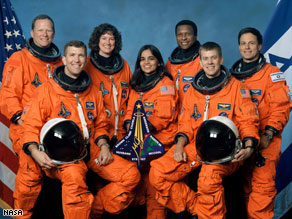
Columbia crew members were killed when the shuttle broke apart upon re-entering Earth's atmosphere.

Columbia crew members were killed when the shuttle broke apart upon re-entering Earth's atmosphere.


But the report also acknowledged that "the breakup of the crew module ... was not survivable by any currently existing capability."

The spacecraft broke up while re-entering Earth's atmosphere near the end of its mission on February 1, 2003.

The NASA report found the astronauts knew for about 40 seconds that they did not have control of the shuttle before they likely were knocked unconscious as Columbia broke apart around them. Video Watch more details from the report »

The report also found that while crew members were wearing their pressurized suits, one astronaut did not have on a helmet, three were not wearing gloves and none lowered the visors before the module lost cabin pressure. One astronaut also was not seated.

"In this accident, none of those actions would have ultimately made any difference," said former shuttle program manager Wayne Hale, now a deputy NASA administrator.

The graphic, 400-page investigative report relied on video, recovered debris and medical findings, supplemented with computer modeling and analyses. It also includes many recommendations to make space travel safer for future astronauts.

A shuttle-program source told CNN the families of the astronauts who died were brought in specifically to look at the report and even in some cases to help with its preparation. The report took more than five years to complete.

"The members of this team have done an outstanding job under difficult and personal circumstances," said Johnson Space Center director Michael L. Coats. "Their work will ensure that the legacy of Columbia and her heroic crew continues to be the improved safety of future human spaceflights worldwide."

Columbia broke apart some 200,000 feet over Texas -- just minutes before it was to have touched down in Florida. The shuttle's wing was damaged on takeoff when a large piece of heat-reflecting foam ripped off and gouged a hole in it.

During re-entry, the hole allowed atmospheric gases to burn the wing and destroy the spacecraft. The oldest orbiter in the fleet, Columbia had just completed a 16-day science mission. Video Watch the view from the command deck as the shuttle enters the atmosphere »

Killed were commander Rick Husband, pilot Willie McCool, payload commander Michael Anderson and mission specialists David Brown, Kalpana Chawla, Laurel Clark and Ilan Ramon, an Israeli Air Force colonel who was Israel's first astronaut.

By request of the families of the Columbia astronauts, NASA released the report between Christmas and New Year's so that the astronauts' children would be at home where they could discuss the findings with their families in private, said former shuttle commander Pam Melroy, deputy project manager for the investigation team.

"It was a way for us to work through our grief about the accident," said Melroy about compiling the report. "This was one of the hardest things I've ever done."

The report stated that "after the crew lost consciousness due to the loss of cabin pressure, the seat inertial reel mechanisms on the crews' shoulder harnesses did not lock.

"As a result, the unconscious or deceased crew was exposed to cyclical rotational motion while restrained only at the lower body. Crew helmets do not conform to the head. Consequently, lethal trauma occurred to the unconscious or deceased crew due to the lack of upper body support and restraint."

Another section of the report focused on the pressure suits used by the space shuttle crew on launch and re-entry. It said the suits were not part of the initial design of the orbiter and that depressurization "occurred so rapidly that the crew members were incapacitated within seconds, before they could configure the suit for full protection from loss of cabin pressure."

Melroy said investigators took some comfort in data that suggests the Columbia crew died abruptly and without suffering.

"Of course, we were relieved," she told reporters during a NASA conference call Tuesday afternoon. "It is a very small blessing, but we'll take them where we can find them."

The NASA team's report evaluated every aspect of the crew cabin infrastructure, including the design of the safety belts and helmets worn by the crew. The report also included recommendations to improve spacecraft design and crew safety.

Those recommendations cover a broad range of subjects from crew training, procedures, restraints and individual safety equipment to spacecraft design methods and recommendations regarding future accident investigations.

"By learning these lessons and ensuring that we continue the journey begun by the crews of Apollo 1, Challenger, and Columbia, we help to give meaning to their sacrifice and the sacrifice of their families," the report stated. "It is for them, and for the future generations of explorers, that we strive to be better and go farther.

The report will have little if no effect on the nine remaining space shuttle flights to come. NASA is mothballing the shuttle program in 2010 as it begins a new program, Constellation, designed to send astronauts back to the moon.

There is expected to be about a five-year hiatus in manned U.S. space flight as NASA transitions to the new program, which it hopes will launch in 2015.

Original here

Update: Mars Rovers approaching five years of service, still kicking

By Rick C. Hodgin

Pasadena (CA) - The two Mars rovers operating right now on the surface of Mars, Spirit and Opportunity, will turn five the 3rd and 24th respectively. Their original 90-days of service has been surpassed by more than 20x as both rovers still carry out missions even today on the red planet - weather permitting, of course.

Image
Artist's rendition of the rover Spirit on surface of Mars. The rovers are nearly as tall as an average person and send back stereoscopic images (two cameras) which present images as our eyes would see them. View the slideshow (link below) for some truly amazing images from Spirt and the other rover, Opportunity. Credit: NASA.


Together, the rovers have sent back over 250,000 images, travelled more than 13 miles, climbed a mountain, descended into craters, struggled with Martian sand traps and aging and failing equipment. They survived dust storms and sent back more than 36 GB of data via the Mars Odyssey craft permanently in orbit around Mars.

Spirit and Opportunity's energy levels are falling year after year due to an accumulation of dust on the craft's solar panels, along with slowly deteriorating batteries. Said John Callas, project manager for Spirit and Opportunity, "This last winter was a squeaker for Spirit. We just made it through." Spirit was barely able to gather enough solar energy each day to maintain internal heat levels each night to keep delicate instruments and circuits from damage due to extreme cold (it gets well below -100 degrees F on Mars).

New missions are scheduled for Spirit and Opportunity. Spirit will first drive about 200 yards and south of a location observed in 2006 called "Home Plate." It is a plateau and may yield support information about what is believed to be a remnant of explosive volcanic material. Later it will head for a house-sized pit called Goddard.

Opportunity is already off to a place called "Endeavour Crater." It's approximately 14 miles in diameter and more than 20x larger than another crater called Victoria where Opportunity has spent most of the last two years. Opportunity's total journey will be seven miles (as the crow flies) to get there, though it will actually be much longer as the Rover must avoid many obstacles.

Opportunity is already more than one mile along on its journey, and has taken several high resolution images of interesting formations along the way. [When I think about Spirit and Opportunity, I cannot help but get an image of Wall-e in my mind, especially with the image above. If only there were more rovers on Mars that Spirit could get replacement parts from.]

The service Spirit and Opportunity have given mankind exceeded everybody's expectations, both inside and outside of NASA. The information they continue to send back takes our imaginations to flight, soaring with possible future manned missions to Mars and setting first foot on another world. That would be something.

Original here

Too much thinking 'can make you fat'

Too much thinking 'can make you fat'
Despite the low energy cost of mental work, students who participated in the research consumed 23.6 per cent more calories after intellectual tasks Photo: ALEXANDER BRATTELL

Researchers found the stress of thinking caused overeating with heavy thinkers seeking out more calories.

The research team, supervised by Dr Angelo Tremblay, measured the spontaneous food intake of 14 students after each of three tasks.

The first was relaxing in a sitting position, the second reading and summarizing a text, and finally completing a series of memory, attention, and vigilance tests on the computer.

After 45 minutes at each activity, participants were invited to eat as much as they wanted from a buffet.

The researchers had already discovered that each session of intellectual work requires only three calories more than the rest period.

However, despite the low energy cost of mental work, the students spontaneously consumed 203 more calories after summarizing a text and 253 more calories after the computer tests.

This represents a 23.6 per cent and 29.4 per cent increase, respectively, compared with the rest period.

Blood samples taken before, during, and after each session revealed that intellectual work causes much bigger fluctuations in glucose and insulin levels than rest periods.

Jean-Philippe Chaput, the study's main author, said: "These fluctuations may be caused by the stress of intellectual work, or also reflect a biological adaptation during glucose combustion."

The body could be reacting to these fluctuations by spurring food intake in order to restore its glucose balance, the only fuel used by the brain.

Mr Chaput added: "Caloric overcompensation following intellectual work, combined with the fact we are less physically active when doing intellectual tasks, could contribute to the obesity epidemic currently observed in industrialised countries.

"This is a factor that should not be ignored, considering that more and more people hold jobs of an intellectual nature."

The results of the study, carried out at Universite Laval in Quebec, Canada, are published in the journal Psychosomatic Medicine.

Original here