Followers

Monday, August 18, 2008

“Pit Stop”: a new way to return from space


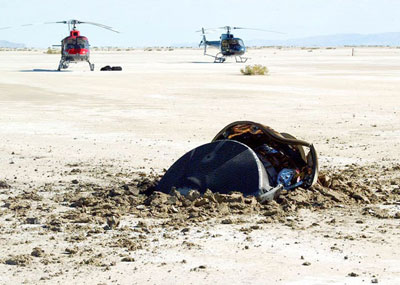
Genesis crash
The crash landing of NASA’s Genesis capsule in 2004 points out some of the problems of active descent and landing systems. (credit: NASA)

This article proposes an unusual way to land objects from orbit and probes returning from deep space. I won’t dwell on details best left for future study, but will suggest enough possibilities to encourage more study of the concept. The use of airbags to help spacecraft land on Mars is a recent example of just how important it is to consider unconventional recovery options like the one described here.

The goal is to reduce or eliminate the usual weight penalty and reliability issues associated with parachutes, touchdown cushioning rockets, water flotation devices, and other complex paraphernalia normally required to softly land a space vehicle on the Earth. New concepts deserve a memorable name, so I call this recovery system “Pit Stop” for reasons that will soon be obvious.

In this scenario, reentry of the spacecraft would be conventional until it slows and descends in the atmosphere to an altitude of perhaps 15,000 meters. At that height the landing capsule might separate from the disposable heat shield, which then drops away. The heat shield could remain attached, but it might present extra thermal problems for the recovery facility on the ground. Aerodynamic control surfaces would then pitch the vehicle over into a vertical dive where it would reach a terminal velocity of perhaps 100 meters per second.

The goal is to reduce or eliminate the usual weight penalty and reliability issues associated with parachutes, touchdown cushioning rockets, water flotation devices, and other complex paraphernalia normally required to softly land a space vehicle on the Earth.

Signals from stationary Global Positioning System (GPS) transmitters on the ground near the landing site, in conjunction with the Orbital GPS system, would help direct the capsule’s final decent. Like a “smart bomb” the vehicle would aim for an exact spot on the earth’s surface. Ground-based vertical wind profilers would provide real-time meteorological updates for the guidance and control system. Other terminal guidance aids, for example LIDAR (light detection and ranging) or active laser tracking might also be used to achieve great accuracy.

In this “Pit Stop” concept, the landing capsule, carefully steered in its plunge to earth, would aim for the opening of a deep vertical shaft set into the ground. The capsule would dive into this hole while still falling at terminal velocity.

The recovery shaft would extend straight down into the earth for hundreds of meters and be closed off and pressure tight at its base. Detailed shaft shape and depth would affect the desired deceleration rate. For recovery of an object that could withstand high G-loads, the shaft might be only a few hundred meters deep. For a low G-load recovery, a shaft over a thousand meters deep would probably be required.

The landing capsule would fit loosely in the entrance of the pit, but clearance would tighten with depth. As the capsule descends, air would flow around the vehicle through the narrowing gap between it and the shaft wall. Appropriate vehicle shaping might encourage it to seek a stable position in the center of the shaft, but it’s also possible it might be pulled toward a wall by aerodynamic effects. Since scraping against the shaft wall is possible, abrasion could be addressed by coating the shaft with a film of water or other material. As the capsule descends, it would act as a piston, compressing the air in front of its direction of travel. It would slow down rapidly because the compressed air would behave like a soft, pneumatic spring.

Eventually the spacecraft would stop. In one scenario, as air escapes around its body, the vehicle would slowly sink down to the bottom of the pit and finally be stopped by a cushioning system. Airlocks at the bottom would open and a human recovery crew would gain access.

As the capsule speeds down the shaft, there is some possibility that the air compressed below might not escape fast enough to give the desired deceleration profile. If so the vehicle could stop and then bounce back upward, propelled by the compressed air, then halt, then descend again to a stop, then rise, then descend, etc., in a sequence of elevator –like up and down moves that slowly dampen out. One way to prevent rebound would be to contour the sides of the spacecraft so that air can vent by (or maybe even through) its body. Another way to avoid a pogo stick affect might be to arrange the primary shaft to nestle concentrically inside a larger outer tube. Vent holes or slots between the two shafts would release air from under the capsule at a controlled rate.

The best site for “Pit Stop” ground stations would be a place with no wind, but light or steady local winds could be compensated for by the vehicle’s terminal guidance. Daily upper atmospheric variables such as density, high altitude winds and irregular de-orbit burn characteristics all introduce uncertainty in the final reentry path. These unknowns could be addressed by installing several “Pit Stop” capture facilities spaced kilometers apart along the reentry ground track in the general landing area. The final choice of which receiving pit to use would be made when the capsule begins its atmospheric dive toward the ground.

The “Pit Stop” recovery scheme should work with a wide range of vehicles. When the system is proven to be reliable, it may be especially attractive for use with manned vehicles that pay a big weight penalty to achieve soft-landing capability. Shaft recovery provides pneumatic cushioning that’s inherently automatic and reliable. The vehicle guidance and control system must be absolutely trustworthy, but the directional precision needed for such control is demonstrated regularly in existing military applications.

When the system is proven to be reliable, it may be especially attractive for use with manned vehicles that pay a big weight penalty to achieve soft-landing capability.

Back in 2004 the parachute system failed on a Chinese reentry vehicle, yet the capsule remained basically intact after smashing through the roof of a house. In the same year, when the chutes on NASA’s Genesis capsule malfunctioned, that deep space probe hit the Utah desert traveling at almost 100 meters per second. Relatively soft soil kept the capsule from disintegrating and much of the payload was recovered. These two rare accidents show that it is possible for a spacecraft to survive after falling through the lower atmosphere with no retarding devices and striking the ground.

Thus, a totally successful soft landing is mostly a matter of controlling the final deceleration. It makes perfect sense to put equipment on the ground to do this rather than to carry heavy landing devices on the vehicle. An underground recovery system based on this “Pit Stop” concept could become routine when it’s appreciated that such a scheme would be simple, safe, and economical.

James C. McLane III worked as an engineer for over 20 years in NASA’s manned space program. An Associate Fellow in the American Institute of Aeronautics and Astronautics and a licensed Professional Engineer in the State of Texas, his current job in the oil and gas industry allows him to view human space activities from a fresh perspective.

Original here

Dark Matter is Missing From Cosmic Voids

Written by Nancy Atkinson


Cosmic voids really are devoid of matter. Astronomers have found that even the pervasive 'dark matter' which accounts for about 80% of the mass of the universe is not present in these voids, which are areas of vast emptiness in space that can be tens of millions of light-years across. "Astronomers have wondered for a quarter-century whether these voids were 'too big' or 'too empty' to be explained by gravity alone," said University of Chicago researcher Jeremy Tinker, who led the new study using data from the Sloan Digital Sky Survey II (SDSS-II). "Our analysis shows that the voids in these surveys are exactly as big and as empty as predicted by the 'standard' theory of the universe."

The largest 3-dimensional maps of the universe show that galaxies lie in filamentary superclusters interlaced by cosmic voids that contain few or no bright galaxies. Researchers using SDSS-II and the
Two-Degree Field Galaxy Redshift Survey (2dFGRS) have concluded that these voids are also missing the "halos" of invisible dark matter that bright galaxies reside in.

A central element of the standard cosmological theory is cold dark matter, which exerts gravity but does not emit light. Dark matter is smoothly distributed in the early universe, but over time gravity pulls it into filaments and clumps and empties out the spaces between them. Galaxies form when hydrogen and helium gas falls into collapsed dark matter clumps, referred to as "halos," where it can form luminous stars.

But astronomers were not sure if the areas that are devoid of galaxies were also devoid of dark matter, or if the dark matter was there, but for some reason stars just didn't form in these voids.
The research team used bright galaxies to trace the structure of dark matter and compared it with computer simulations to predict the number and sizes of voids.
Princeton University graduate student Charlie Conroy measured the sizes of voids in the SDSS-II maps. "When we used galaxies brighter than the Milky Way to trace structure, the biggest empty voids we found were about 75 million light years across," said Conroy. "And the predictions from the simulations were bang-on."

The sizes of voids are ultimately set, Conroy explained, by the small variations in the primordial distribution of dark matter, and by the amount of time that gravity has had to grow these small variationsinto large structures.

The agreement between the simulations and the measurements holds for both red (old) and blue (new) galaxies, said Tinker. "Halos of a given mass seem to form similar galaxies, both in numbers of stars and in the ages of those stars, regardless of where the halos live."

Tinker presented his findings today at an international symposium in Chicago, titled "The Sloan Digital Sky Survey: Asteroids to Cosmology." A paper detailing the analysis will appear in the September 1 edition of The Astrophysical Journal, with the title "Void Statistics in Large Galaxy Redshift Surveys: Does Halo Occupation of Field Galaxies Depend on Environment?"

Original here

10 Best Science Fiction Planets

arrakis-425.jpg

Most planets featured in science fiction tend to be rather generic. These planets are usually convenient celestial bodies upon which to pitch a narrative tent for a few scenes before the plot moves on. Generic planets also tend to be one-note, reflecting some particular environment on Earth. You have your ice-worlds, desert worlds, lava worlds, jungle worlds, water worlds, city worlds, forest worlds (in particular, forests that look like those near the city of Vancouver), earthquake worlds, and so on.

But sometimes an author will create a world whose presence has a weight and ring of truth, a world that feels like it could happily go on existing on its own terms, with or without a protagonist or antagonist strolling around on its surface. Setting aside obviously artificial habitats like ring words or hollowed out asteroids, here are my top ten best science fiction planets, in chronological order:

  1. Solaris (1961): You may or may not have liked the films, but Stanislaw Lem’s conception of a world so utterly alien that it defies any genuine human comprehension still resonates.
  2. Dune (1965): Best Planet Ever. At first glance, it’s just one of those one-note desert worlds. But Frank Herbert created a complete ecosytem, deep geological history, and a complex native society to go with his sand-covered planet. Dune is no mere backdrop, it drives the plot of Herbert’s complex saga as inexorably as the law of gravity.
  3. Annares (1974): Ursula LeGuin’s novel The Dispossessed featured two worlds, a more-or-less straightforward analog for cold-war era Earth, and the far more interesting Annares, where settlers established an anarcho-syndicate-based society in a bid to be free from authoritarian government. LeGuin created a believable society for Annares—including the unpleasant side effects (such as intellectual conservatism) of trying to create a human utopia.
  4. Mote Prime (1974): In Larry Niven and Jerry Pournelle’s The Mote in God’s Eye, this is the homeworld of the Moties, a species that, due to cosmic happenstance, has been bottled up in its solar system ever since it evolved. Mote Prime is planet which has become a palimpsest, mutely testifying to the endless cycles of technological development and collapse experienced by the trapped Moties.
  5. LV-426 (1979): The dread planet that featured briefly in Alien, and was the location for 1986’s Aliens. In both movies, LV-426 is perfectly portrayed as part of a cosmos utterly indifferent to human concerns, such as staying alive.
  6. Dagobah (1980): The Star Wars franchise is a planet-producing machine: Tatooine, Yavin IV, Alderan, Hoth, Endor, Coruscant, Naboo, etc, etc. But Dagobah sticks out for its organic messiness and claustrophobic atmosphere that stands in contrast to the typical open spaces that provide the large stages for the movies’ space opera.
  7. Lusitania (1986): The setting of Orson Scott Card’s Speaker for the Dead, Lusitania is the exception that proves the rule—it is fascinating not because it is a rich world, but because its ecosystem has so little diversity, and the implications that has for the book’s characters.
  8. Red, Green and Blue Mars (1993-1996): Kim Stanley Robinson’s Mars Trilogy has become the standard against which all hard science fiction books about Mars are weighed. Beginning in the near future, with the founding of the first permanent outpost on the red planet, and continuing for two centuries as Mars is terraformed, Robinson’s Mars is a meticulously researched and believable fictional version of our solar system neighbor.
  9. P2 (2004): P2 is a world orbiting the nearby Barnard’s star, and it is settled by fantastically advanced exiles from the solar system in Wil McCarthy’s Lost in Transmission. Unfortunately, all their technology can’t make up for some basic deficiencies in the carrying capacity of the Barnard system, and what happens to P2 is reminiscent of Flowers for Algernon, but on a planetary scale.
  10. Nasqueron (2004): A gas giant, home of the maddeningly unconcerned Dwellers, and location of much of Iain M. Banks’ The Algebraist. Nasqueron becomes not just the huge canvas the Banks requires for his sprawling tales, but also becomes an integral element in the plot, as the protagonist struggles to understand the Dwellers.
Original here