Followers

Sunday, July 27, 2008

Astronomers Discover a Supernova/Gamma Ray Burst Hybrid

Written by Ian O'Neill
Spiral galaxy NGC 2770 with two supernovae SN 2007uy and SN 2008D. Credit: NASA

Just when we thought we were beginning to understand what supernovae and gamma ray bursts were all about. Astronomers have just uncovered the true nature of what they thought was a regular supernova observed in January. At the time, it looked like a supernova emitting a 5-minute long burst of X-rays. But these X-rays were of a lower energy (known as "soft" X-rays) than expected leading some to believe this was a normal emission from a supernova explosion that was being observed during detonation (astronomers don't usually get the chance to observe a star as it explodes and usually have to make do with analysing the supernova remnant). However, it is now believed this strange supernova event may have been emissions from a dying star at an intermediate mass, neither producing a supernova nor a gamma ray burst, but a combination of both…

Orbiting above Earth on January 9th 2008, the NASA/STFC/ASI Swift telescope caught a rare glimpse of what seemed to be a "normal" supernova at the precise moment of detonation. This observation was completely by luck, as Swift was already observing a supernova remnant (SN 2007uy) in spiral galaxy NGC 2770 that had exploded the previous year (90 million light-years away near the Lynx constellation). Then, as Swift was retrieving data from the SN 2007uy remnant, SN 2008D blasted a 5-minute long burst of X-rays in the same galaxy making this the first supernova to be directly observed.

However, looks can be deceiving. Researchers from a host of institutions including Italian National Institute for Astrophysics (INAF), the Max-Planck Institute for Astrophysics (MPA) and the European Southern Observatory (ESO) have analysed the supernova data thoroughly and at first agreed with the original assessment that it was indeed "normal."

"What made this event very interesting is that the X-ray signal was very weak and 'soft', very different from a gamma-ray burst and more in line with what is expected from a normal supernova." - Paolo Mazzali, INAF's Padova Observatory/MPA, research leader.
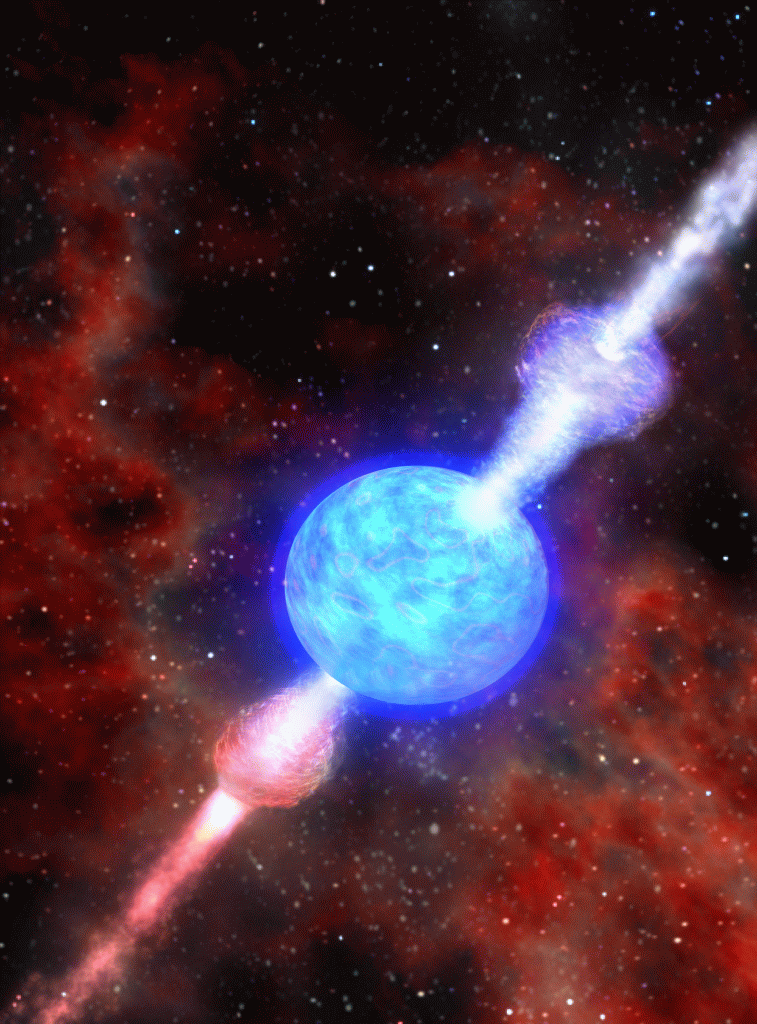
Dana Berry/SkyWorks Digital

Artist impression of the twin jets from a GRB. Credit: Dana Berry/SkyWorks Digital

However, astronomers at the Asiago Observatory in Northern Italy had designated the event as a Type 1c supernova, more commonly associated with long-period gamma-ray bursts. Type 1c supernovae are generated by hydrogen-poor progenitor stars with helium-rich outer layers prior to exploding at the end of their lives. But SN 2008D generated soft X-rays more associated with smaller stellar explosions. Therefore SN 2008D was probably produced by a star that was massive at birth (approximately 30 solar masses), rapidly using up its hydrogen fuel in its short life until it was only 8-10 solar masses. At this point it exploded, probably creating a remnant black hole. This chain of thought has led Paolo Mazzali and his team to think SN 2008D was produced by an object of a mass at the boundary of a normal supernova and gamma-ray burst.

"Since the masses and energies involved are smaller than in every known gamma-ray burst related supernova, we think that the collapse of the star gave rise to a weak jet, and that the presence of the Helium layer made it even more difficult for the jet to remain collimated, so that when it emerged from the stellar surface the [X-ray] signal was weak." - Massimo Della Valle, co-investigator.

Researcher and co-author Stefano Valenti points out that this discovery indicates that all black hole-producing supernovae have the potential to be gamma-ray burst progenitors. "The scenario we propose implies that gamma-ray burst-like inner engine activity exists in all supernovae that form a black hole," he added.

Original here

A new era in search for 'sister Earths'?

A Jupiter-sized planet passes in front of its star in this artists impression of a transiting exoplanet. Photo: NASA ESA and G. Bacon
A Jupiter-sized planet passes in front of its star in this artist's impression of a transiting exoplanet. Photo: NASA, ESA, and G. Bacon

Research presented at a recent astronomical conference is being hailed as ushering in a new era in the search for Earth-like planets by showing that they are more numerous than previously thought and that scientists can now analyze their atmospheres for elements that might be conducive to life.

“This conference was very well timed. People came with new results. It clicked together. There was a lot of excitement,” said Professor of Astronomy Dimitar Sasselov, who heads Harvard’s Origins of Life Initiative and who co-chaired the conference’s Scientific Organizing Committee. “What happened this spring was a tipping point in the field.”
The International Astronomical Union (IAU) symposium, held in May at the American Academy of Arts and Sciences in Cambridge, was sponsored by the Harvard Origins of Life Initiative, the California Institute of Technology’s Michelson Science Center, the Massachusetts Institute of Technology, and the IAU. Its focus was “Transiting Planets,” or the technique of discovering planets by measuring changes in the light of distant suns when a planet passes in front of them.

“The age of the discovery of Earth-like planets started last week,” Sasselov said shortly after the conference concluded. “We can say this is the moment where we started the exploration of planets like Earth.”

Astronomers using a variety of techniques have discovered more than 300 planets circling other stars since 1995, when a Swiss team announced finding the first Jupiter-mass planet orbiting a sun-like star, but few of them bear any resemblance to rocky planets like Earth. Because planets are far smaller and dimmer than the star they circle, most techniques rely on detecting not the planet itself, but its effects on its star, such as changes in the star’s light or wobbles in the star’s rotation due to a planet’s gravitational tug as it circles. Consequently, most of the planets found so far have been large gas giants such as our own solar system’s Jupiter, Saturn, or Neptune, thought to be incapable of sustaining life.

That has been changing since the 2004 announcement of the discovery of the first “super-Earth,” a potentially rocky planet 14 times larger than Earth circling a star in the southern constellation Altar, and with the development of new instruments that astronomers believe will be able to find planets close to Earth’s size.
At the conference, Christophe Lovis, a scientist at the University of Geneva who is collaborating with the Harvard Origins of Life Initiative, announced findings that small, rocky worlds are not only present in the universe, they’re common, outnumbering the large gas giants by as much as a 3-to-1 ratio.

“This finding was not expected and very welcome,” Sasselov said. “It means planets like Earth are abundant and we can study them.”

Sasselov said rocky planets up to five times Earth’s size should be detectable with the new generation of instruments coming on line such as the Harvard Origins of Life Initiative’s spectrometer equipped with the new laser astro-comb, developed at the Harvard-Smithsonian Center for Astrophysics. The spectrometer which will be deployed in the Canary Islands for exoplanet research sometime in 2010.

“Five times larger than Earth is actually pretty good from the point of view of geochemistry and biochemistry,” Sasselov said. “Ultimately, we want to go down to sister Earths, as people call it. It’s my personal belief that super-Earths are as hospitable to life as Earths, but we need to compare them. People want to know if there are planets just like ours out there.”

The second major finding to emerge from the conference shows that researchers can get an idea of conditions on any planets that they do find, Sasselov said. Presented by Harvard’s Cabot Associate Professor of Astronomy David Charbonneau, the results presented the first compilation of the atmospheric spectrum of a planet orbiting another star.

The spectrum, put together for the atmosphere of a gas giant 60 light-years away, uses the light emitted or absorbed by the planet to detect what molecules are present in the atmosphere, in this case, methane, potassium, sodium, water vapor, and small particulate haze, among others. Though researchers have been able to detect single elements that make up the atmosphere of planets since 2001, this is the first time the complete makeup of the atmosphere of an extrasolar planet has been determined.

“We can actually do this; it is amazing,” Sasselov said. “We can look at a planet 60 light-years away and tell you what’s in the atmosphere. This is really a big deal.”

Knowing a planet’s atmospheric makeup can help astronomers determine whether the conditions for life are present.

“What really keeps me up at night is the potential to apply the techniques we’ve developed to study the atmospheres of gas giant exoplanets to the soon-to-be discovered Earth-like exoplanets,” Charbonneau said. “We could conduct a search for the presence of specific molecules indicating biological activity on the planet’s surface.”

Original here

Microbes Beneath Sea Floor Genetically Distinct

Tiny microbes beneath the sea floor, distinct from life on the Earth's surface, may account for one-tenth of the Earth's living biomass, according to an interdisciplinary team of researchers, but many of these minute creatures are living on a geologic timescale.

"Our first study, back in 2006, made some estimates that the cells could double every 100 to 2,000 years," says Jennifer F. Biddle, PhD. recipient in biochemistry and former postdoctoral fellow in geosciences, Penn State. "Now we have the first comprehensive look at the genetic makeup of these microbes." Biddle is now a postdoctoral associate at the University of North Carolina, Chapel Hill.

The researchers looked at sediment samples from a variety of depths taken off the coast of Peru at Ocean Drilling Site 1229. They report their findings in the July 22 online issue of the Proceedings of the National Academy of Sciences.

"The Peruvian Margin is one of the most active surface waters in the world and lots of organic matter is continuously being deposited there," says Christopher H. House, associate professor of geoscience. "We are interested in how the microbial world differs in the subsea floor from that in the surface waters."

The researchers used a metagenomic approach to determine the types of microbes residing in the sediment 3 feet, 53 feet, 105 feet and 164 feet beneath the ocean floor. The use of the metagenomics, where bulk samples of sediment are sequences without separation, allows recognition of unknown organism and determination of the composition of the ecosystem.

"The results show that this subsurface environment is the most unique environment yet studied metagenomic approach known today," says House. "The world does look very different below the sediment surface." He notes that a small number of buried genetic fragments exist from the water above, but that a large portion of the microbes found are distinct and adapted to their dark and quiet world.

The researchers, who included Biddle; House; Stephan C. Schuster, associate professor; and Jean E. Brenchley, professor, biochemistry and molecular biology, Penn State; and Sorel Fitz-Gibbon, assistant research molecular biologist at the Center for Astrobiology, UCLA, found that a large percentage of the microbes were Archaea, single-celled organisms that look like Bacteria but are different on the metabolic and genetic levels. The percentage of Archaea increases with depth so that at 164 feet below the sea floor, perhaps 90 percent of the microbes are Archaea. The total number of organisms decreases with depth, but there are lots of cells, perhaps as many as 1,600 million cells in each cubic inch.

" These microbes influence the Earth's long-term carbon cycle and also these microbes may be quite ancient," says Biddle.

If the rest of the world is like the Peruvian Margin, then at least one tenth and as much as a third of the Earth's biomass could be these tiny microbes living in the mud. However, this population lives at an unusual rate. Single-celled organisms usually consume food for energy and then rather than grow larger, simply divide and reproduce themselves. While the Bacteria Escherichia Coli, as an example, doubles its numbers every 20 minutes, these Archaea double on the order of hundreds or thousands of years and consume very little energy.

"In essence, these microbes are almost, practically dead by our normal standards," says House. "They metabolize a little, but not much."

According to House, organisms metabolizing at such slow rates is what we could expect to find in other areas of our solar system because such environments have much less energy available than on Earth. Perhaps, similar organisms may be in hydrothermal vents beneath the ice of Europa -- the second moon of Jupiter -- or in subsurface aquifers of Mars.

"We do not expect the microbes in other places to be these microbes exactly," says House. "But, they could be living at a similar slow rate."

Biddle notes that these microbes could survive major Earth impacts by asteroids, so the subsea floor could be a refuge for life during extinction events. Now this study shows they may be a reservoir of novel genetic material as well. Her future research will focus on understanding the lifestyle of the microbes.

"For example, how do they die?" asks Biddle. "It is a simple question that we cannot answer."

The National Science Foundation, the NASA Astrobiology Institute, U.S. Department of Energy and Pa. Department of Health supported this work.

Original here