Followers

Thursday, May 22, 2008

How could anyone not know that Titan's atmosphere is mostly nitrogen?

However, the question, which springs from this mea culpa post by Phil Plait on his always-entertaining Bad Astronomy blog, speaks to one half of a serious issue that has puzzled me for many years, and, in more recent times, caused me considerable concern as a parent.

If everyone makes mistakes -- and they do -- why are so many people unwilling to accept the mistakes of others (not to mention their own)?

From Plait's post:

Well, I blew it, and I suppose I should make it official.

In my second video answering questions from sixth graders, I said that Titan's atmosphere is mostly methane.

Bzzzzzt. It's mostly nitrogen (specifically, N2, like in Earth's atmosphere). It's only about 1% methane.

A simple slip of the tongue, albeit repeated twice, he explains.

In this case, comments on the post are understanding, sympathetic and even amusing -- "It's OK, dude. It's hard to answer questions like that when you're ducking to avoid sniper fire." That's as would be expected, given that those writing are fans of the blogger.

But it isn't always that way, as anyone who has put their words and thoughts before the public for any length of time can attest. I cannot imagine there are too many writers who have not been on the receiving end of this question: "How could someone who doesn't know (fill in the blank) write for (fill in the blank)?"

My temptation has always been to reply that I have considered their point, tendered my resignation, and expect that they will help pay for next week's groceries.

One of those responding to Plait's mistake raises a more useful point:

In actuallity, your providing those 6th graders (and many others) with an invaluable lesson about how science works. Science makes mistakes. Science can change when better answers are found. I think those kids will be much richer in their quest for knowledge because of it. Kudos.

Yes, I left the spelling errors in there on purpose; can't tell you whether the writer intended to do the same.

After all, it's OK to make mistakes, not only in spelling, science, journalism and responding to bloggers, but in all walks of life. That doesn't mean that mistakes don't have consequences or that there isn't a world of difference between saying methane when you mean nitrogen ... and, say, drunken driving.

But, in general, it's OK to make mistakes. I've said as much to my daughter Emma countless times (as has her Mom), including a stretch when it was a bedtime ritual that I would utter that exact phrase 100 times as fast as possible while I counted and she giggled. That she can be so devastated by her own mistakes -- at age 6 -- is no laughing matter.

Emma knows that her Dad writes stories on the Internet ... and that he makes mistakes. Tonight I'll get to show her the story about the really smart scientist who made (for him) a really silly one. Maybe that will help.

Not sure what to do about the infallible and those unwilling to forgive.

Welcome regulars and passersby. Here are a few more recent Buzzblog items. And, if you'd like to receive Buzzblog via e-mail newsletter, here's where to sign up.

The REAL sticking point between Microsoft and Yahoo!

Worst of the lot for two years running: PCMall and PCConnection.

YouTube's down, everybody panic.

Photographer/Internet 1, Bully 0.

"Bribe" or miswording: You make the call.

This Year's 25 Geekiest 25th Anniversaries.

Google renames the Persian Gulf.

Top 10 Buzzblog posts for '07: Verizon's there, of course, along with Gates, Wikipedia and the guy who lost a girlfriend to Blackberry's blackout.

8 can't-miss tech predictions ... for 1998

Original here

Birth cry of a supernova

Very, very cool news today: for the first time in history, astronomers have unambiguously observed the exact moment when a star explodes.

Whoa.

The Quick Version

NGC 2770 is a galaxy at the relatively close distance of 84 million light years away. On January 9, 2008, a massive star in it exploded, and instead of finding out days or weeks later, astronomers caught it in the act, right at the moment, in flagrante delicto. The image above, from the Gemini observatory, shows the galaxy and its new supernova.

We’ve seen lots of stars explode; thousands in fact. But because of the mechanics of how a star actually explodes, by the time we notice the light getting brighter, the explosion may be hours or even days old. This time, because it was caught so early, astronomers will learn a whole passel of new knowledge about supernovae.

That’s the brief summary… but this event has a rich back story. Pardon me the lengthy description, but this is very cool stuff, and I think you’ll enjoy having the details.

The Death of a Star

I’ve explained before how massive stars explode. After a few million years of generating energy by fusing light elements into heavier ones (hydrogen to helium, helium to carbon, and so on), the core runs out of fuel. Iron builds up in the very center of the star, and no star in the Universe has what it takes to fuse iron. It’s like ash piling up in a fireplace. At some point, so much iron builds up that it cannot support its own weight, and the ball of iron collapses.

In a millisecond, more than the mass of the Sun’s worth of iron collapses from an object the size of the Earth to a ball only about 20 kilometers across. Weirdly, it happens so quickly that the surrounding layers don’t have time to react, to fall down (think Wile E. Coyote running over a cliff’s edge). While they hesitate and just start to fall, all hell breaks loose below them.
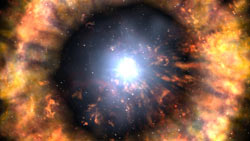
Dana Berry artwork of a supernova
Artist’s drawing of a supernova

The collapse of the core generates a vast explosion, a shock wave of incomprehensible power that moves out from the surface of the collapsed core into the layers of gas still surrounding it. Like a tsunami of energy, this shock wave works its way up to the surface of the star. The energy is so huge that the material it slams into gets heated to millions of degrees. When the shock wave breaks out through the surface, it bellows its freedom to the Universe with a flash of X-rays, a brief but incredibly brilliant release of high-energy light.

After that flash (what’s called the shock breakout), the explosion truly begins. The outer layers of the star — gas that can have many times the mass of the Sun, octillions of tons — blast outwards. The star tears itself apart, and becomes a supernova.

So — and this is important — the X-ray flash is emitted immediately, but the bright visible light follows it later.

Millions of light years away, astronomers on Earth patrol the sky with telescopes. We use ones that are sensitive to visible light, the kind we see with our eyes. They can see large parts of the sky easily, and that’s good since we never know where the next supernova will be. But that also means we don’t see the shock breakout; we notice the star exploding usually days after the actual event occurs.

We really want to see the supernova as early as possible; the physics, the mechanics of the explosion depend critically on what happens early on, so the younger we see the new supernova, the better we can tune our models and understand precisely how and why stars explode. An X-ray telescope would detect the first moments of the event, but they typically have too small a field of view to catch one as it occurs. The odds are simply way too small, and no one has ever actually witnessed the predicted X-ray flash from the shock breakout.

Until now.

Now, finally, we have seen a supernova go off right as the moment happened. And, ironically, it was an accident, an amazing coincidence, that allowed it to happen.

The Astronomer, the Coincidence, the Mobilization

NASA’s Swift satellite is sensitive to X-rays; it’s designed to detect the flash of light from gamma-ray bursts, which are a particular flavor of supernova. But Swift can also be used to observe older events, too. Alicia Soderberg, an astronomer at Princeton, had gotten time on Swift to observe SN2007uy, a supernova that had exploded the month before. This was a routine observation, and on January 9, 2008, she was actually on travel, ironically giving a talk about supernovae!

When she got back from her talk, she logged onto the Swift archive to look at the data as it came in, and got a huge surprise. There was a second, new source of X-rays in the field of view… and it was incredibly bright. She quickly realized what she was seeing: a new supernova caught in the act, the X-ray flash of the shock breakout detected for the first time. She realized Swift had caught the birth of supernova 2008D as it was happening.
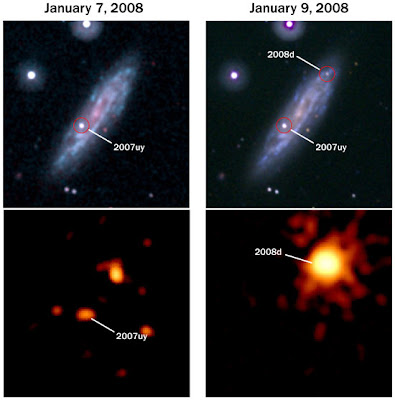
The image above shows the pre- and post-discovery Swift images of the event. The upper images are in ultraviolet light, and show the galaxy NGC 2770. The bottom images show the same field, but in X-rays, where the galaxy itself is dim, but stars and star-forming gas clouds are bright. The images in the left column were taken on January 7, 2008 and the right column two days later, during the shock breakout. You can see how SN2008D is rather unremarkable in ultraviolet, but in X-rays is tremendously bright, washing out everything else in the galaxy.

Mind you, the X-ray flash from the supernova only lasted about five minutes. If Swift had not been looking right at the spot at right at that moment, this once-in-a-lifetime opportunity would have been lost.

That’s how cool this is.

I can only imagine what Soderberg was thinking when she saw that image on the lower right. Wow. But she acted quickly. She and her colleagues immediately mobilized a team of astronomers using telescopes across the world — and above it — to observe the newly born supernova. Using the Gemini telescope (the same one that made the beautiful picture at the top of this post) they quickly got spectra of the event, and it confirmed the event: she had bagged an exploding star. The energies of a supernova are so great that the outer layers explode outwards at a fraction of the speed of light, and velocities measured from SN2008D indicated expansion rates of more than 10,000 kilometers per second — fast enough to cross the entire Earth in just over one second, and faster than the expansion in a typical supernova.

The Aftermath

Because so many people observed this supernova from so early on, a vast wealth of knowledge was collected. The progenitor star probably started out life with about 30 times the mass of the Sun. Over a few million years, it shed quite a bit of its mass through a dense, super-solar wind, blowing off most (but probably not all) of its outer layers. When the core collapsed, the shock wave tore through what was left of the star’s envelope. Because there wasn’t as much material as usual surrounding the core, the energy of the blast could accelerate the gas outward at an unusually high speed. It’s also been determined that the explosion wasn’t symmetric: it wasn’t a perfect sphere, with the gas expanding in every direction equally. Instead it was off-center, with gas on one side of the explosion moving outward faster than on the other. This has been seen before, but never so early on.

All of this adds up to an incredible boon for astronomers. The observations collected are yielding a huge amount of information not just on this particular event, but on the basic parameters of supernova explosions themselves. Because of this happy coincidence — a new supernova occurring near an older one, and just as a powerful and sensitive X-ray observatory was pointed in the right direction, and with attentive scientists keeping an eye on their data — astronomers will take a huge step forward in understanding these tremendous explosions.

The Importance

You should understand something else here, too. As the blast wave moves through the gas of the star, the elements in that gas undergo an explosive fusion, creating new, heavier elements. Elements like iron, calcium, and gold. The hemoglobin in your blood, the bones in your body, and the wedding ring on your finger — all of these can trace their lineage back to a star that exploded like SN2008D. Every heavy element in the Universe was created in such an event, in the heart and fury of a supernova.

We owe our very existence to stars that explode.

That’s why work like this is important. Through science like this we can determine our own origins, from the hydrogen that formed a millisecond after the Big Bang, through elements built up in normal stars like the Sun, through heavy elements created in supernovae… to us.

That’s where science leads. We look out to the farthest reaches of the Universe, and we wind up seeing ourselves.

Original here

Who Owns the Moon? The Case for Lunar Property Rights

Published in the June 2008 issue.

The moon has been in plain view for all of human history, but it's only within the past few decades that it's been possible to travel there. And for just about as long as the moon has been within reach, people have been arguing about lunar property rights: Can astronauts claim the moon for king and country, as in the Age of Discovery? Are corporations allowed to expropriate its natural resources, and individuals to own its real estate?

The first article on the subject, "High Altitude Flight and National Sovereignty," was written by Princeton legal scholar John Cobb Cooper in 1951. Various theoretical discussions followed, with some scholars arguing that the moon had to be treated differently than earthbound properties and others claiming that property laws in space shouldn't differ from those on Earth.

With the space race in full flower, though, the real worry was national sovereignty. Both the United States and the Soviet Union wanted to reach the moon first but, in fact, each was more worried about what would happen if they arrived second. Fears that the competition might trigger World War III led to the 1967 Outer Space Treaty, which was eventually ratified by 62 countries. According to article II of the treaty, "Outer Space, including the moon and other celestial bodies, is not subject to national appropriation by claim of sover­eignty, by means of use or occupation, or by any other means."

So national appropriation was out, along with fortifications, weapons and military installations. But what about private property rights—personal and corporate? Some scholars argue that property rights can exist only under a nation's dominion, but most believe that property rights and sovereignty can be distinct.

In something of an admission that this is the case, nations that thought the Outer Space Treaty didn't go far enough proposed a new agreement, the Moon Treaty, in 1979. It explicitly barred private property rights on the moon. It also provided that any development, extraction and management of resources would take place under the supervision of an international authority that would divert a share of the profits, if any, to developing countries.

The Carter administration liked the Moon Treaty, but space activists, fearful that the sharing requirement would subjugate American mineral claims to international partners, pressured the Senate, ensuring that the United States didn't ratify it. Although the Moon Treaty has entered into force among its 13 signatories, none of those nations is a space power.

So property rights on the moon are still the subject of international discussion. But would anyone buy lunar land? And what would it take to establish good title?

The answer to the first question is clearly "yes." Lots of people would buy lunar land—and, in fact, lots of people have, sort of. Dennis Hope, owner of Lunar Embassy, says he's sold 500 million acres as "novelties." Each parcel is about the size of a football field and costs $16 to $20. Buyers choose the location—except for the Sea of Tranquility and the Apollo landing sites, which Hope has placed off-limits.

To convey good title, Hope essentially wrote the U.N. to say he was going to begin selling lunar property. When the U.N. didn't respond with an objection, he asserted that this allowed him to proceed. Although I regard his claim to good title as dubious, his customers have created a constituency to recognize his position. If he sells enough lunar property, it may become a self-fulfilling prophecy.

So there's demand, even for iffy titles. But what would it take to establish title, rather than Dennis Hope's approximation? That's not so clear. In maritime salvage law, which also deals with property rights beyond national territory, actually being there is key: Those who reach a wreck first and secure the property are generally entitled to a percentage of what they recover. There's even some case law allowing that presence to be robotic rather than human. Traditionally, claims to unclaimed property require long-term presence, effective control and some degree of improvement. Those aren't bad rules for lunar property, either. But who would recognize such titles?

Individual nations might. In the 1980 Deep Seabed Hard Mineral Resources Act, the United States recognized deep-sea mining rights outside its own territory without claiming sovereignty over the seabed. There's nothing to stop Congress from passing a similar law relating to the moon. For that matter, there's nothing to stop other nations from doing the same.

Ideally, title would be recognized by an international agreement that all nations would endorse. The 1979 Moon Treaty was a flop, but there's no reason the space powers couldn't agree on a new treaty that recognizes property rights and encourages investment. After all, the international climate has warmed to property rights and capitalism over the past 30 years.

I'd like to see something along these lines. Property rights attract private capital and, with government space programs stagnating, a lunar land rush may be just what we need to get things going again. I'll take a nice parcel near one of the lunar poles, please, with a peak high enough to get year-round sunlight and some crater bottoms deep enough to hold ice. Come visit me sometime!

PM contributing editor, Instapundit blogger and University of Tennessee law professor Glenn Harlan Reynolds is the author (with Robert P. Merges) of Outer Space: Problems of Law and Policy.

Original here