Take one part Spitzer Space Telescope, one part Hubble Space Telescope, and two galaxies. Shake well, bake covered for a few million years, and get this:
 |
| Click to embiggen, or go here for access to much higher res images! |
Coooool.
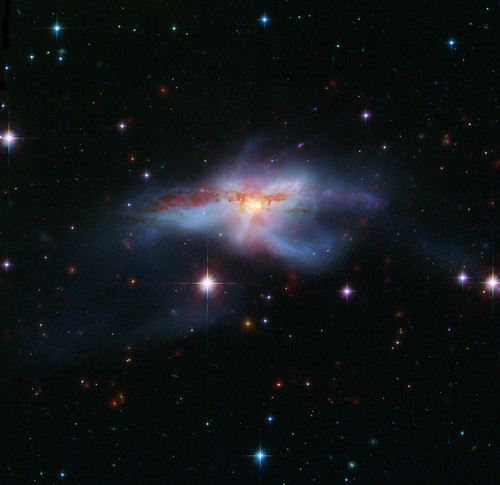
This is NGC 6240, what used to be two galaxies but are in the process of becoming one. We see colliding galaxies all over the sky, but what makes this one special is the timing and its location.
Collisions take hundreds of millions of years, starting from the first tentative approach to the complete merging of the two. But the different steps of the process take different amounts of time. The initial approach takes a long time, for example, so we see lots of those. The actual physical merging also takes many millions of years, so we commonly see that as well. But while the outer parts of the galaxy are interacting, so are the cores. The time between the outer parts settling down and the inner parts doing their thing can be fairly short. NGC 6240 is right now at the moment in its life where the two galaxies have started to merge, but the cores of the two are still distinct.
Also, the farther away we look, the more volume of the Universe we see, so the more galaxies we see. In the distant Universe we do see galaxies in this stage, but they are so far away that details are unclear. NGC 6240 is only 400 million light years away, which is a ridiculously long way in human terms, but close enough in cosmic scales that Hubble and Spitzer can see those details.
The outer parts of the galaxy are still messy, churned up by the violence of the collision. Huge gas and dust clouds have collided, which triggers an immense burst of star formation. Newborn stars create a lot of dust — giant organic molecules that are very efficient at absorbing the visible light Hubble detects. However, warm dust emits infrared light, and Spitzer can see that.
So in the Hubble image we see the stars and gas tossed all over the place, and the chaotic dust (in red) detected by Spitzer. Combined, the two images tell a tale of what a pair of galaxies is like just before their cores start to merge, a snapshot in an instant of a catastrophic event.
… and in a few million years, the fireworks will really begin. All big galaxies have a supermassive black hole in their hearts, and the two bruisers in this pair will start to work their magic as well. The cores will combine, and the gravitational wake of the two black holes interacting will make the previous merging process seem like a gentle breeze. The gas and dust in the center of the merging monsters will become incredibly turbulent, mixed violently and suddenly, creating a vast wave of star formation. A huge amount of energy will blast out of the core, and get absorbed by the dust there. It will convert that high energy radiation into infrared, pouring out the invisible light, and NGC 6240 may become a ULIRG, an ultra luminous infrared galaxy.
It will pose no threat to us at its vast distance, but we’ll have a great view of this step in a galactic merger as well. Too bad we have to wait several million years for it. So for now we’ll just have to be satisfied with catching this merger in the act. There’s still plenty to learn from it.


 Posts
Posts

