Followers

Monday, March 16, 2009

Greenland ice tipping point 'further off than thought'

David Adam in Copenhagen

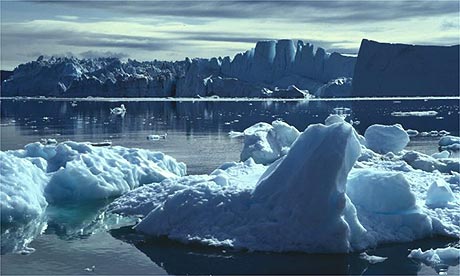
Melting ice sheet in Greenland

The vulnerability of Greenland's ice has been overestimated, says a climate expert. Photograph: Corbis

The giant Greenland ice sheet may be more resistant to temperature rise than experts realised. The finding gives hope that the worst impacts of global warming, such as the devastating floods depicted in Al Gore's film An Inconvenient Truth, could yet be avoided.

Jonathan Bamber, an ice sheet expert at the University of Bristol, told the conference that previous studies had misjudged the so-called Greenland tipping point, at which the ice sheet is certain to melt completely. "We're talking about the point at which it is 100% doomed. It seems quite an important number to get right." Such catastrophic melting would produce enough water to raise world sea levels by more than 6m.

"We found that the threshold is about double what was previously published," Bamber told the Copenhagen Climate Congress, a special three-day summit aimed at updating the latest climate science ahead of global political negotiations in December over a successor to the Kyoto treaty. It would take an average global temperature rise of 6C to push Greenland into irreversible melting, the new study found.

Previous estimates, including those in the recent reports from the Intergovernmental Panel on Climate Change, said the critical threshold was about 3C – which many climate scientists expect to be reached in the coming decades.

"The threshold temperature has been substantially underestimated in previous studies. Our results have profound implications for predictions of sea level rise from Greenland over the coming century," the scientists said.

Bamber said previous studies used a very simple model to mimic how the Greenland ice will melt as temperatures rise. The new study, conducted jointly with colleagues in the US and Denmark, used a more complex simulation to better recreate the conditions in the real world. "I'm not saying it's definitely right, but more of the physics is in there."

He said evidence from past climates confirmed that Greenland should be able to survive temperature rises higher than 3C. An ice sheet about half the size is known to have persisted there during the Eemian period, about 125,000 years ago, when temperatures were about 5C higher than today.

Bamber said the new study was only concerned with the tipping point at which melting becomes unstoppable. It does not mean that Greenland will not contribute to increased sea level rise if temperatures increase by a few degrees.

"I'm not saying that if you have a temperature rise of 2C then you're not going to lose mass from Greenland, because you are. You warm the planet, ice melts," he added.

Original here

Stern attacks politicians over climate 'devastation'

David Adam in Copenhagen

Politicians have failed to take on board the severe consequences of failing to cut world carbon emissions, according to Nicholas Stern, the economist commissioned by Gordon Brown to analyse the impact of climate change.

His stark warning about the potentially "devastating" consequences of global warming came as scientists issued a desperate plea last night for world leaders to curb greenhouse gas emissions or face an ecological and social disaster.

More than 2,500 climate experts from 80 countries at an emergency summit in Copenhagen said there is now "no excuse" for failing to act on global warming. A failure to agree strong carbon reduction targets at political negotiations this year could bring "abrupt or irreversible" shifts in climate that "will be very difficult for contemporary societies to cope with".

In a significant break from the scientific tradition not to comment directly on policy, the experts insisted politicians must stand up to "vested interests that increase emissions" and "build on a growing public desire for governments to act". They called for a "shift from ineffective governance and weak institutions to innovative leadership in government, the private sector and civil society".

Katherine Richardson, a climate scientist at the University of Copenhagen, who organised the three-day summit, said: "We have to act and we have to act now. We need politicians to realise what a risk it is they are taking on behalf of their own constituents, the world's societies and, even more importantly, future generations. All of the signals from the Earth system and the climate system show us we are on a path that will have enormous and unacceptable consequences."

Speaking after giving a keynote speech, Stern said he feared that politicians had not grasped the seriousness of the crisis. "Do the politicians understand just how difficult it could be? Just how devastating four, five, six degrees centigrade would be? I think not yet. Looking back, the Stern review underestimated the risks and underestimated the damage from inaction."

This week's conference was arranged to offer an update on scientific thinking on global warming, and underpin political attempts to agree a new global climate treaty to replace the Kyoto protocol. Campaigners have called for such a deal to be signed at UN talks in December, also in Copenhagen, though officials have warned the discussions could drag on into next year.

Scientists at the Copenhagen meeting will publish its full findings in June, but last night they issued their conclusions as a strongly worded statement"

"The climate system is already moving beyond the patterns of natural variability within which our society and economy have developed and thrived. These parameters include global mean surface temperature, sea-level rise, ocean and ice sheet dynamics, ocean acidification, and extreme climatic events. There is a significant risk that many of the trends will accelerate, leading to an increasing risk of abrupt or irreversible climatic shifts."

The summary adds: "There is no excuse for inaction. We already have many tools and approaches - economic, technological, behavioural, management - to deal effectively with the climate change challenge. But they must be vigorously and widely implemented."

In the conference centre that will also host the December UN negotiations, experts at this week's meeting presented a string of new studies that suggested global warming could strike harder and sooner than expected.

They said carbon emissions have risen more in recent years than anyone thought possible, and the world's natural carbon stores could be losing the ability to soak up human pollution.

The conference also heard that:

· A 4C rise could turn swaths of southern Europe to desert.

· Sea levels will rise twice as fast as official estimates predict.

· Modest warming could unleash a carbon "time bomb" from Arctic soils.

· A failure to cut emissions could render half of the world uninhabitable.

· Rising temperatures could kill off 85% of the Amazon rainforest.

Several experts at the conference warned that temperatures are likely to soar beyond the 2C target set by European politicians, though they are reluctant to say so publicly. "The 2C target is gone and 3C is difficult. I think we're heading for 4C at least," one said. Oxford University yesterday announced that it would hold a conference in September to discuss the implications of a rise of 4C or more.

Kevin Anderson, research director at the UK Tyndall Centre for Climate Change Research, said: "The scientists have lost patience with our carefully constructed messages being lost in the political noise. And we are now prepared to stand up and say enough is enough."

Peter Cox, a climate expert at Exeter University, said: "People have been saying this individually for a long time. This is just a much louder and concerted shout from our community."

Rob Bailey, senior climate adviser for Oxfam said: "The verdict of the world's top scientists is clear. The big question now is whether the worlds richest countries, who created the climate crisis, will act before it's too late. Our climate is changing fast and if left unchecked its impacts, particularly on the world's poorest people, will be devastating."

Original here

Amazon Rainforest Will Suffer Catastrophic Damage, Even in Best Case Scenario

by Adam Shake

Landscape Painting II

Even if the lowest temperature rises occur under Global Warming, the Amazonian rainforest is going to suffer catastrophic damage.

The damage will be so severe that it will cause irreversible changes to the world’s weather patterns, which is expected to bring more storms, floods and heat waves to Britain.

Up to 40 per cent of the rainforest will be lost if temperature rises are restricted to 2C, which most climatologists regard as the least that can be expected by 2050.

Climate change researchers issued this assessment of the forest’s fragility after discovering a time-lag in the effects of temperature rises on the forest.

It had previously been thought that the trees and other vegetation, and the vast range of animals living among them, would be safe if temperatures rose no more than 2C. Researchers have now found that even 2C will destroy large tracts of the forest.

A 3C rise is likely to result in 75 per cent of the forest disappearing and a 4C rise, regarded as the most likely increase this century unless greenhouse gas emissions are greatly reduced, will kill off 85 per cent of the forest.

Chris Jones, of the Met Office Hadley Center in Exeter, told a scientific conference in Copenhagen that 20 to 40 per cent of the forest will be killed off by 2050 if there is a 2C rise.

“We are committed to losing a fair degree of the forest,” Dr Jones told scientists. “Everything above 1C commits us to some forest loss.”

Until Dr Jones presented his findings it had been assumed that the Amazonian rainforest was safe from severe climate-related loss until temperatures rose more than 3C. However, the slowness of forests to respond to change hid the likely real impact.

Peter Cox, of the University of Exeter, said of the finding that at least a fifth of the Amazonian rainforest was almost certainly doomed. “Ecologically it would be a catastrophe and it would be taking a huge chance with our own climate. The tropics are drivers of the world’s weather systems and killing the Amazon is likely to change them for ever. We don’t know exactly what would happen but we could expect more extreme weather,” Professor Cox said.

Our manipulation of the environment has been so drastic and so severe that we are just beginning to understand the implications of what we are doing. Unfortunately, in many cases, it is too late. Some, but not all of the Global Warming manifestations are reversible.

We are already seeing animal and human migration patterns due to man made Global Warming. We are already seeing the effects of the increased severity and frequency of storms and flooding as a result of man made Global Warming. We are seeing previously unknown effects on our planet every day, that we have caused, and we are just learning, much too slowly, how these effects impact us.

Learn, share, and live wisely.

Source: Times Online