Followers

Wednesday, March 11, 2009

Blue Ducks likely to die out in UK after male birds get together

By Caroline Gammell

Blue Ducks likely to die out in UK after male birds get together
Blue ducks Ben and Jerry at the Arundel Wetland Centre in West Sussex Photo: SOLENT

Keepers at a bird sanctuary in West Sussex hoped that the last remaining female Blue Duck in the country - called Cherry - might mate with either of the drakes, Ben or Jerry.

But neither male duck appeared interested and are now inseparable at the Arundel Wetland Centre, leaving Cherry to her own devices.


Centre warden Paul Stevens said he was disappointed that efforts to produce new Blue Duck offspring had failed but said the two male birds made "a lovely couple".

"They stay together all the time, parading up and down their enclosure and whistling to each other as a male might do with a female he wants to mate with," he said.

"People who visit the centre think they're a fantastic couple, without really coming around to the idea that they are two males.

"They both have very big personalities and people come from all over the country to come and see them.

Cherry doesn't seem bothered by it, she's just happy to keep herself to herself."

Blue ducks originate from New Zealand but there were thought to be just three birds in the UK.

Keepers initially introduced Ben to Cherry, but neither seemed keen. They then brought Jerry down from a sanctuary in London.

Mr Stevens said: "Cherry showed some interest in him. She displayed typical mating behaviour - she approached him and called to him, she even looked like she was nesting.

"We thought it was great and it was all going to happen but nothing ever did."

Mr Stevens said the male ducks were then placed in the same enclosure: "To our surprise the two males really took to each other and it was obvious that they really liked each other.

"It would have been nice to get a last clutch of eggs from Cherry but Ben and Jerry do make a lovely couple."

Original here

Jeremy Clarkson and Michael O'Leary won't listen to green cliches and complaints about polar bears

George Marshall

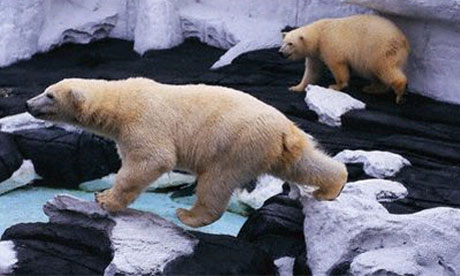
Polar bears

Academics meeting in Bristol at the weekend for Britain's first conference on the psychology of climate change argued that the greatest obstacles to action are not technical, economic or political — they are the denial strategies that we adopt to protect ourselves from unwelcome information.

It is true that nearly 80% of people claim to be concerned about climate change. However, delve deeper and one finds that people have a remarkable tendency to define this concern in ways that keep it as far away as possible. They describe climate change as a global problem (but not a local one) as a future problem (not one for their own lifetimes) and absolve themselves of responsibility for either causing the problem or solving it.

Most disturbing of all, 60% of people believe that "many scientific experts still question if humans are contributing to climate change". Thirty per cent of people believe climate change is "largely down to natural causes", while 7% refuse to accept the climate is changing at all.

How is it possible that so many people are still unpersuaded by 40 years of research and the consensus of every major scientific institution in the world? Surely we are now long past the point at which the evidence became overwhelming?

If only belief formation were this simple. Having neither the time nor skills to weigh up each piece of evidence we fall back on decision-making shortcuts formed by our education, politics and class. In particular we measure new information against our life experience and the views of the people around us.

George Lakoff, of the University of California, argues that we often use metaphors to carry over experience from simple or concrete experiences into new domains. Thus, as politicians know very well, broad concepts such as freedom, independence, leadership, growth and pride can resonate far deeper than the policies they describe.

None of this bodes well for a rational approach to climate change. Climate change is invariably presented as an overwhelming threat requiring unprecedented restraint, sacrifice, and government intervention. The metaphors it invokes are poisonous to people who feel rewarded by free market capitalism and distrust government interference. It is hardly surprising that political world view is by far the greatest determinant of attitudes to climate change, especially in the US where three times more Republicans than Democrats believe that "too much fuss is made about global warming".

An intuitive suspicion is then reinforced by a deep distrust of the key messengers: the liberal media, politicians and green campaign groups. As Jeremy Clarkson says, bundling them all together: "...everything we've been told for the past five years by the government, Al Gore, Channel 4 News and hippies everywhere is a big bucket of nonsense." Michael O'Leary, the founder of Ryanair, likens "hairy dungaree and sandal wearing climate change alarmists" to "the CND nutters of the 1970s". These cultural prejudices, however simplistic, align belief with cultural allegiance: "People like us," they say, "do not believe in this tripe."

However much one distrusts environmentalists, it is harder to discount the scientists… depending, of course, on which scientists one listens to. The conservative news media, continues to provide a platform for the handful of scientists who reject the scientific consensus. Of the 18 experts that appeared in Channel 4's notorious sceptic documentary The Great Global Warming Swindle, 11 have been quoted in the past two years in the Daily and Sunday Telegraph, five of them more than five times.

Dr Myanna Lahsen, a cultural anthropologist at the University of Colorado, has specialised in understanding how professional scientists, some of them with highly respected careers, turn climate sceptic. She found the largest common factor was a shared sense that they had personally lost prestige and authority as the result of campaigns by liberals and environmentalists. She concluded that their engagement in climate issues "can be understood in part as a struggle to preserve their particular culturally charged understanding of environmental reality."

In other words, like the general public, they form their beliefs through reference to a world view formed through politics and life experience. In order to maintain their scepticism in the face of a sustained, and sometimes heated, challenge from their peers, they have created a mutually supportive dissident culture around an identity as victimised speakers for the truth.

This individualistic romantic image is nurtured by the libertarian right think tanks that promote the sceptic arguments. One academic study of 192 sceptic books and reports found that 92% were directly associated with right wing free market think tanks. It concluded that the denial of climate change had been deliberately constructed "as a tactic of an elite-driven counter-movement designed to combat environmentalism".

So, given that scepticism is rooted in a sustained and well-funded ideological movement, how can sceptics be swayed? One way is to reframe climate change in a way that rejects the green cliches and creates new metaphors with a wider resonance. So out with the polar bears and saving the planet. Instead let's talk of energy independence, and the potential for new enterprise.

And then there is peer pressure, probably the most important influence of all. So, when dealing with a sceptic, don't get into a head to head with them. Just politely point out all the people they know and respect who believe that climate change is a serious problem — and they aren't sandle-wearing tree huggers, are they?

Original here

Gray Wolf Will Lose Protection in Part of U.S.

By JIM ROBBINS

HELENA, Mont. — In a blow to environmental groups and a boost for ranchers, the Obama administration announced Friday that it would take the gray wolf off the endangered species list in Montana and Idaho, though it left the predator under federal protection in Wyoming.


Agence France-Presse — Getty Images

The gray wolf will remain on the federal endangered species list in Wyoming.

The delisting allows Montana and Idaho to assume complete management of the animal, which will include a hunting season in both states. The move also delists wolves in the western Great Lakes and parts of Oregon, Utah and Washington.

The new policy was announced by the Bush administration in January, but its adoption was delayed so the incoming Obama administration could assess it.

“The recovery of the gray wolf throughout significant portions of its historic range is one of the great success stories of the Endangered Species Act,” Interior Secretary Ken Salazar said. “Today, we have more than 5,500 wolves, including more than 1,600 in the Rockies.”

Jenny Harbine, a lawyer with Earthjustice in Bozeman, Mont., which has sued to keep the federal protections, said, “We’re disappointed.” She added, “Idaho has shown an eagerness to kill as many wolves as possible, and they are drawing up plans for killing wolves as we speak.”

In 2007, Gov. C. L. Otter of Idaho said he favored reducing the number of wolves there to 100 from more than 800. He also said he would be the first to buy a wolf hunting license.

Officially, however, Idaho has agreed in its state plan to maintain a population of 500 wolves. Montana has agreed to keep 400 wolves. If the number of animals falls below 150 total and 15 breeding pairs for three years in a row, the wolf will be relisted in that state.

Environmentalists sued last year to stop the delisting under the Bush administration. They argued that without protection, wolf numbers were not great enough to assure connectivity between animals in different regions of the northern Rockies, which is crucial to assuring long-term survival.

A federal judge agreed, issuing a temporary injunction to stop the delisting. The Fish and Wildlife Service then dropped its proposal for more study. “We now have information that wolves routinely move back and forth between recovery areas,” said Ed Bangs, the agency’s recovery coordinator in Helena, Mont. “We’ve resolved that issue.”

Environmentalists say they will take the issue back to court.

While state wolf management plans in Idaho and Montana assure protection, federal officials say, the one in Wyoming falls short, so the wolf will remain listed there. Yet in most of Wyoming, the wolf is designated as a predator and could be shot on sight if it were to be delisted. Controversy erupted last year when people chased wolves down on snowmobiles and killed them from planes.

Original here