
Followers

Monday, January 5, 2009

The carbon footprint of nuclear war

Duncan Clark Posted by Duncan Clark

Almost 700m tonnes of CO2 would be released into the Earth's atmosphere by even the smallest nuclear conflict, according to a US study that compares the environmental costs of developing various power sources
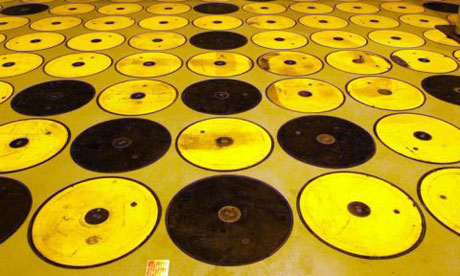
A yellow and black pattern shows full (black) and additional space (yellow) at the temporar storage of High level radioactive nuclear waste at Sellafield nuclear plant

Nuclear waste stored at Sellafield. One of the side-effects of developing nuclear power is the risk of war, the report warns. Photograph: AFP

Just when you might have thought it was ethically sound to unleash a nuclear attack on a nearby city, along comes a pesky scientist and points out that atomic warfare is bad for the climate. According to a new paper in the journal Energy & Environmental Science, even a very limited nuclear exchange, using just a thousandth of the weaponry of a full-scale nuclear war, would cause up to 690m tonnes of CO2 to enter the atmosphere – more than UK's annual total.

The upside (kind of) is that the conflict would also generate as much as 313m tonnes of soot. This would stop a great deal of sunlight reaching the earth, creating a significant regional cooling effect in the short and medium terms – just like when a major volcano erupts. Ultimately, though, the CO2 would win out and crank up global temperatures an extra few notches.

The paper's author, Mark Z Jacobson, a professor of civil and environmental engineering at Stanford University, calculated the emissions of such a conflict by totting up the burn rate and carbon content of the fabric of our cities. "Materials have the following carbon contents: plastics, 38–92%; tyres and other rubbers, 59–91%; synthetic fibres, 63–86%; woody biomass, 41–45%; charcoal, 71%; asphalt, 80%; steel, 0.05–2%. We approximate roughly the carbon content of all combustible material in a city as 40–60%."

But why would a Stanford engineer bother calculating such a thing? Given that the nuclear exchange would also kill up to 17 million people, who's going to be thinking about the impact on global warming?

The purpose of the paper is to compare the total human and environmental costs of a wide range of different power sources, from solar and wind to nuclear and biofuels. One of the side-effects of nuclear power, the report argues, is an increased risk of nuclear war: "Because the production of nuclear weapons material is occurring only in countries that have developed civilian nuclear energy programs, the risk of a limited nuclear exchange between countries or the detonation of a nuclear device by terrorists has increased due to the dissemination of nuclear energy facilities worldwide."

"As such," Jacobson continues, "it is a valid exercise to estimate the potential number of immediate deaths and carbon emissions due to the burning of buildings and infrastructure associated with the proliferation of nuclear energy facilities and the resulting proliferation of nuclear weapons … Although concern at the time of an explosion will be the deaths and not carbon emissions, policy makers today must weigh all the potential future risks of mortality and carbon emissions when comparing energy sources."

I'm not a huge fan of nuclear energy, and I agree that a large roll-out of atomic power must on some level increase the likelihood of nuclear terrorism or war. However, it does strike me as faintly absurd to try and quantify this risk – particularly the way Jacobson does it. Here's how he crunches the numbers:

"If one nuclear exchange as described above occurs over the next 30 years, the net carbon emissions due to nuclear weapons proliferation caused by the expansion of nuclear energy worldwide would be 1.1–4.1g CO2 per kWh, where the energy generation assumed is the annual 2005 generation for nuclear power multiplied by the number of year being considered."

In other words, if nuclear power leads one exchange of fifty 15 kilotonne nuclear devices over 30 years, then that equates to 4.1 grams of extra CO2 for each kilowatt of nuclear energy produced. Why, you might ask, has Jacobson chosen one exchange, 50 nuclear war heads and 30 years? Good question. Those figures, as far as I can tell, are entirely arbitrary, and as such I'm rather surprised that the Royal Society for Chemistry are prepared to publish them in their journal.

Putting those doubts to one side for a moment, it's interesting to note that nuclear looks very bad in the report even if you ignore the warfare component of the carbon footprint. Far more serious (by a factor of 15 to 25) is nuclear's opportunity cost: the emissions savings lost during the decades of planning and building of each nuclear station. Once again, however, there's no explanation about how these figures are calculated, so it's hard to know whether they're valid.

Either way, nuclear doesn't come out as badly as first- or second-generation biofuels. These, the author remarks, are "ranked lowest overall and with respect to climate, air pollution, land use, wildlife damage, and chemical waste," and may actually "worsen climate and air pollution" relative to fossil fuels. Carbon capture and storage also gets a thumbs down. By contrast, wind, solar and marine energy score well on the wide-ranging criteria, which include carbon emissions, land demands and even thermal pollution.

As the first study to compare energy sources in so many different ways, the report is both interesting and welcome. Unfortunately, it's unlikely to make much of an impact – not just because there's no mention of the economics of each energy source, but because the half-baked quantification of nuclear war's climate impact makes the whole study seem somewhat unconvincing.

Original here

Coffee Beans As The Next Great Auto Fuel?

Posted by Samuel R. Avro

Not only will the fuel be cheap, but the exhaust will also produce the wonderful aroma of coffee.

Scientists at the University of Nevada, Reno, researching the prospect of extracting oil from used coffee grounds report that the process is not that difficult. The cheap and environmentally friendly biofuel is abundant enough to potentially manufacture several hundred million gallons a year to power cars and trucks.

The idea was formed by accident says the chief researcher. “I had left my coffee out one night, and the next morning, I noticed that there was a kind of oil around the edge of the cup,” Mano Misra, a professor of engineering said. “Every cup of coffee has it. I decided to do some tests on the oil.”

The analysis proved that the grounds contained roughly 10 to 15 percent oil by weight. The researchers then extracted the oil with standard chemistry techniques and converted it to biodiesel.

For the study, the team collected leftover grounds of espressos, cappuccinos and other coffee preparations from the Starbucks coffee chain.

Being that the process is not particularly energy intensive, the researchers estimated that biodiesel could be produced for about a dollar a gallon.

According to the Department of Agriculture, the world’s coffee production is more than 7.2 million tons per year.

The study was first reported toward the end of last year in The Journal of Agricultural and Food Chemistry.

Fill 'er up with an unleaded cappuccino?

The resulting coffee-based fuel –which smells like java– is more stable than traditional biodiesel due to coffee’s high antioxidant content, according to the researchers.

“We have found that biodiesel created from spent coffee grounds is stable over a longer period of time than other forms of biodiesel that have been created from feed stocks such as soy and corn,” Misra said. “Biodiesel from spent coffee grounds is a low-cost ‘green’ form of fuel that shows a significant reduction of carbon dioxide emission. It’s an excellent source for biodiesel.”

One hurdle, Dr. Misra said, is in the organized collection of the spent beans. Therefore, the researchers plan on setting up a pilot operation this year using waste from a local bulk roaster.

It won’t be a complete fix for reducing America’s dependence on oil, but it can be a help while at the same time providing a nice aroma for those in the vicinity. The researchers report that the exhaust actually smells like coffee.

“It won’t solve the world’s energy problem,” Dr. Misra said of his work. “But our objective is to take waste material and convert it to fuel.”

Original here

Coral growth in decline at Great Barrier Reef

Image: Corals in Great Barrier Reef
Jurgen Freund / Freund Factory
These massive porites corals at the Great Barrier Reef are hundreds of years old. The corals are like trees in that each year a new band is laid down in their skeletons that record their environmental histories.

By Miguel Llanos

The rate at which corals absorb calcium from seawater to calcify their hard skeletons — and thus grow — has declined dramatically in the last two decades and signs point to manmade greenhouse gas emissions as the culprit, according to a study of samples from Australia's Great Barrier Reef.

Researchers with the Australian Institute of Marine Science looked at the skeletal records of porites corals collected over the years at 69 reefs along the 1,600-mile-long Great Barrier Reef. Those corals, some 400 years old, showed that calcification declined by 13 percent between 1990 and 2005.

"The data suggest that such a severe and sudden decline in calcification is unprecedented in at least the past 400 years," the researchers stated in the study, published in the peer-reviewed journal Science.

A reef expert not involved in the study described it as "very important." In a commentary posted on newsvine.com for msnbc.com, John Bruno added that "the findings are frankly pretty scary."

"Slower growth might not seem like a big problem, but reef scientists are concerned that this will exacerbate the impacts of other threats to coral reefs," said Bruno, an associate professor of marine ecology at the University of North Carolina at Chapel Hill. "For example, it will slow the vertical growth of corals, making it harder for them to keep up with rising sea levels.

"It could also slow recovery from other disturbances such as coral bleaching episodes and destructive storms," Bruno added. Bleaching occurs when corals expel the organisms living inside that create the colors found on reefs.

The study's authors themselves wrote that "precipitous changes in the biodiversity and productivity of the world's oceans may be imminent" given how central coral reefs are to marine ecosystems.

Changes tracked via skeletal rings
The researchers sampled porites coral, which can grow over centuries into massive boulders. Porites also lay down annual growth rings, making it possible to compare specific years to water temperature records and other data.

Several potential causes were ruled out by the researchers, among them sewage and other runoff since many samples were originally far from the coast. Disease was also ruled out because the samples were all from corals that had been healthy.

That, they wrote, left "two most likely" factors, both tied to carbon dioxide emissions: warming sea temperatures and more acidic oceans as CO2 raises the pH levels of the seas.

The researchers noted that their findings confirm lab experiments and computer models predicting negative impacts of rising carbon dioxide on corals.

"If temperature and carbonate saturation are responsible for the observed changes, then similar changes are likely to be detected in the growth records from other regions and from other calcifying organisms," they warned.

How fast can coral adapt?
Bruno noted that "we will almost certainly see this problem grow over the next few centuries" due to greenhouse gas emissions. "The only questions are by how much, how quickly corals can acclimate to climate change and what the broader impacts will be."

Image: Coral reef
Jurgen Freund / Freund Factory
The skeletons of corals provide habitat for tens of thousands of species associated with reefs.

Bleaching has also been tied to warming waters, and adds to the pressure on corals. The Great Barrier Reef saw severe bleaching in 1998 and 2002 — the two hottest summers on record there — and officials warned that the northern end of the reef could see severe bleaching again over the next few months during the Southern Hemisphere's summer.

Bruno warned that while corals are not widely visible their role is critical. "Corals create the physical structure that thousands of other species depend on," he said. "They play a role analogous to trees that create forests. When corals die, so do the fish and invertebrate animals that live on reefs."

Original here