Followers

Sunday, December 7, 2008

What is truth serum?

INTERROGATION CHAIR: Can "truth serum" make criminals fess up?
© iStockPhoto / Stefan Klein

The baby-faced gunman of Mumbai, Azam Amir Kasab, now in the custody of Indian police, is the sole surviving attacker in the three-day rampage that began on the night of November 26 and left more than 170 people dead and scores of others injured.

After the attacks, Indian officials immediately began pointing fingers at longtime rival, Pakistan, as the source of the 10 militants—a charge that Pakistan President Asif Ali Zardari disputed last night on CNN. During police interrogations, Kasab himself claimed to hail from the Punjab region of Pakistan and to have trained with the Pakistan-based extremist group, Lashkar-e-Taiba.

Of course, Kasab could be making this all up. The only way that interrogators can tap a man's memory is to ask him. But what if the person is unwilling to spill the beans or, at least, the real ones? If only there were only a way to plug a USB cable to the back of Kasab's head and just download the experiences.

While such technology may be the stuff of science fiction, Indian government officials have announced they will employ another technique that seems to leap from the pages of a 1940s pulp novel: truth serum. Also known as narcoanalysis, administering psychoactive drugs for interrogation purposes has been around for just under a century, but it has been viewed with skepticism from the start. Indeed, the practice is banned in most democracies, and evidence obtained from such an interrogation would have a hard time making it into an American court.

But could "truth serum" reliably extract the truth from this man and other criminal targets? We asked Alison Winter, a science historian at the University of Chicago, who has studied the origins and applications of truth serum.

What does the term "truth serum" mean?
That's a term that was used to describe the use of certain drugs, most commonly barbiturates like sodium amytal and sodium pentothal, to try to extract truthful statements from people about their past experiences. What the term really meant was that the people who used the serum believed that it made people unable to censor themselves and they would just empty their memories into a narrative statement.

Who discovered these effects?
In the mid-1910s, Dr. Robert House was an obstetrician who noticed that the popular obstetric anesthetic drug, scopolamine, also known as twilight sleep, would put his patients into a state where they would deliver information in a way that seemed automatic.

He didn't want to use it in interrogation, for the purpose of getting people to admit to criminal acts, so this is a quite different beginning from the association we have now. At the time, he wanted to use it to provide support for claims people made about their innocence -- not their guilt. If somebody said 'I wasn't at the crime, I was in the library but nobody saw me,' then, perhaps, this would give support for the claim, because you would think they could not lie under the drug's influence.

It was only later when other people used these drugs that they got the reputation for having the power to force people to provide information against their will.

How did they begin to be used for interrogation?
In the 1930s, there were these committees to evaluate corruption in American policing, and it first came out that police were using these drugs in interrogations to get suspects to incriminate themselves. But there's not a lot of documentation of that.

During World War II, these drugs were used in a very different way. They were the first intravenous anesthetics and were used to treat traumatized soldiers who had lost their memories or had aphasia [loss of the ability to speak or process language due to brain injury]. Doctors found that using these drugs would make it easier for people to say what happened, and this helped them feel better.

As a result, a lot of doctors who had been in the military during the war were familiar with these drugs. Sodium amytal and pentothal were no longer just used as surgical anesthetics, although that was their most common use, but they were sometimes used for this psychiatric purpose of getting people to talk. In most cases, the drugs were not used in interrogations, but to help people talk about their memories in psychiatric consultations. However, some of these military doctors eventually became consultants for police forces or they did psychiatric research for the government and began exploring different ways of using these drugs for interrogation.

Do experts believe they really work?
The idea of a "truth serum" has never been widely accepted. Although there have been waves of enthusiasm for the idea of a drug that can extract information reliably, there has been even more skepticism. Ever since the 1920s, many judges, psychiatrists, and scientists have rejected the idea that there is a drug that can get memories out intact. They have claimed, instead, that it makes people feel like talking, but it also puts them in a state of extreme suggestibility: people will pick up on cues about what questioners want to hear and repeat that back. This is one of the reasons that statements made under the influence of these drugs have never, as far as I know, been accepted in an American court.

After 9/11, there were discussions in the national papers about whether it's a good idea to interrogate suspects using these drugs. Every time there is a desperate need for information from people, you get speculation about whether these drugs are going to get that information. But you also get consistent warnings that the information may be less reliable than what you would get without the drugs. That skepticism was there right form the start 80 years ago.

Original here

EEGs show brain differences between poor and rich kids

University of California, Berkeley, researchers have shown for the first time that the brains of low-income children function differently from the brains of high-income kids.

In a study recently accepted for publication by the Journal of Cognitive Neuroscience, scientists at UC Berkeley's Helen Wills Neuroscience Institute and the School of Public Health report that normal 9- and 10-year-olds differing only in socioeconomic status have detectable differences in the response of their prefrontal cortex, the part of the brain that is critical for problem solving and creativity.

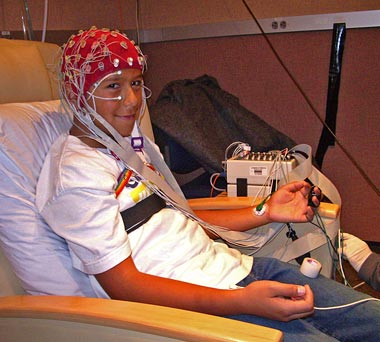
Child wired for EEG to test brain functionElectroencephalography, or EEG, uses electrodes on the scalp and held in place by a cap to measure underlying brain activity. (Lee Michael Perry/UC Berkeley)
Brain function was measured by means of an electroencephalograph (EEG) - basically, a cap fitted with electrodes to measure electrical activity in the brain - like that used to assess epilepsy, sleep disorders and brain tumors.

"Kids from lower socioeconomic levels show brain physiology patterns similar to someone who actually had damage in the frontal lobe as an adult," said Robert Knight, director of the institute and a UC Berkeley professor of psychology. "We found that kids are more likely to have a low response if they have low socioeconomic status, though not everyone who is poor has low frontal lobe response."

Previous studies have shown a possible link between frontal lobe function and behavioral differences in children from low and high socioeconomic levels, but according to cognitive psychologist Mark Kishiyama, first author of the new paper, "those studies were only indirect measures of brain function and could not disentangle the effects of intelligence, language proficiency and other factors that tend to be associated with low socioeconomic status. Our study is the first with direct measure of brain activity where there is no issue of task complexity."

Co-author W. Thomas Boyce, UC Berkeley professor emeritus of public health who currently is the British Columbia Leadership Chair of Child Development at the University of British Columbia (UBC), is not surprised by the results. "We know kids growing up in resource-poor environments have more trouble with the kinds of behavioral control that the prefrontal cortex is involved in regulating. But the fact that we see functional differences in prefrontal cortex response in lower socioeconomic status kids is definitive."

Boyce, a pediatrician and developmental psychobiologist, heads a joint UC Berkeley/UBC research program called WINKS - Wellness in Kids - that looks at how the disadvantages of growing up in low socioeconomic circumstances change children's basic neural development over the first several years of life.

"This is a wake-up call," Knight said. "It's not just that these kids are poor and more likely to have health problems, but they might actually not be getting full brain development from the stressful and relatively impoverished environment associated with low socioeconomic status: fewer books, less reading, fewer games, fewer visits to museums."

Kishiyama, Knight and Boyce suspect that the brain differences can be eliminated by proper training. They are collaborating with UC Berkeley neuroscientists who use games to improve the prefrontal cortex function, and thus the reasoning ability, of school-age children.

"It's not a life sentence," Knight emphasized. "We think that with proper intervention and training, you could get improvement in both behavioral and physiological indices."

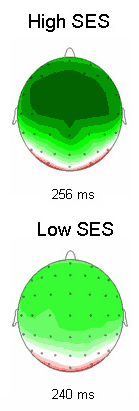
EEG maps of brain activityChildren of high socioeconomic status (SES) show more activity (dark green) in the prefrontal cortex (top) than do kids of low SES when confronted with a novel or unexpected stimulus. (Mark Kishiyama/UC Berkeley)
Kishiyama, Knight, Boyce and their colleagues selected 26 children ages 9 and 10 from a group of children in the WINKS study. Half were from families with low incomes and half from families with high incomes. For each child, the researchers measured brain activity while he or she was engaged in a simple task: watching a sequence of triangles projected on a screen. The subjects were instructed to click a button when a slightly skewed triangle flashed on the screen.

The researchers were interested in the brain's very early response - within as little as 200 milliseconds, or a fifth of a second - after a novel picture was flashed on the screen, such as a photo of a puppy or of Mickey and Minnie Mouse.

"An EEG allows us to measure very fast brain responses with millisecond accuracy," Kishiyama said.

The researchers discovered a dramatic difference in the response of the prefrontal cortex not only when an unexpected image flashed on the screen, but also when children were merely watching the upright triangles waiting for a skewed triangle to appear. Those from low socioeconomic environments showed a lower response to the unexpected novel stimuli in the prefrontal cortex that was similar, Kishiyama said, to the response of people who have had a portion of their frontal lobe destroyed by a stroke.

"When paying attention to the triangles, the prefrontal cortex helps you process the visual stimuli better. And the prefrontal cortex is even more involved in detecting novelty, like the unexpected photographs," he said. But in both cases, "the low socioeconomic kids were not detecting or processing the visual stimuli as well. They were not getting that extra boost from the prefrontal cortex."

"These kids have no neural damage, no prenatal exposure to drugs and alcohol, no neurological damage," Kishiyama said. "Yet, the prefrontal cortex is not functioning as efficiently as it should be. This difference may manifest itself in problem solving and school performance."

The researchers suspect that stressful environments and cognitive impoverishment are to blame, since in animals, stress and environmental deprivation have been shown to affect the prefrontal cortex. UC Berkeley's Marian Diamond, professor of integrative biology, showed nearly 20 years ago in rats that enrichment thickens the cerebral cortex as it improves test performance. And as Boyce noted, previous studies have shown that children from poor families hear 30 million fewer words by the time they are four than do kids from middle-class families.

"In work that we and others have done, it really looks like something as simple and easily done as talking to your kids" can boost prefrontal cortex performance, Boyce said.

"We are certainly not blaming lower socioeconomic families for not talking to their kids - there are probably a zillion reasons why that happens," he said. "But changing developmental outcomes might involve something as accessible as helping parents to understand that it is important that kids sit down to dinner with their parents, and that over the course of that dinner it would be good for there to be a conversation and people saying things to each other."

"The study is suggestive and a little bit frightening that environmental conditions have such a strong impact on brain development," said Silvia Bunge, UC Berkeley assistant professor of psychology who is leading the intervention studies on prefrontal cortex development in teenagers by using functional magnetic resonance imaging (fMRI).

Boyce's UBC colleague, Adele Diamond, showed last year that 5- and 6-year-olds with impaired executive functioning, that is, poor problem solving and reasoning abilities, can improve their academic performance with the help of special activities, including dramatic play.

Bunge hopes that, with fMRI, she can show improvements in academic performance as a result of these games, actually boosting the activity of the prefrontal cortex.

"People have tried for a long time to train reasoning, largely unsuccessfully," Bunge said. "Our question is, 'Can we replicate these initial findings and at the same time give kids the tools to succeed?'"

This research is supported by grants from the National Institute of Mental Health and the National Institute of Neurological Disorders and Stroke of the National Institutes of Health.

Original here

Developing Oil from Canadian Tar Sands Could Kill 160 Million Migratory Birds by 2038