By Jacob Leibenluft
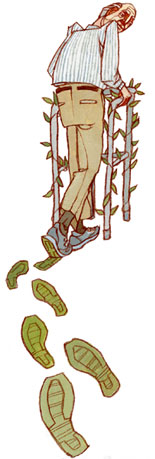
Everyone's always talking about how an aging population, with more retirees, is going to wreak havoc on Social Security and the federal budget. Here's my question: What impact will that have on the planet? After all, my grandparents don't seem to care much about global warming, their refrigerator is from the 1970s, and they use an awful lot of air conditioning at home. Give it to me straight: Are Grandma and Grandpa bad for the environment?
"Do it for the kids" has always been one of the most popular arguments in favor of environmentalism: Older people need to get their act together, or else it's the children who will suffer the environmental consequences. Indeed, in terms of what they buy and how they vote, younger Americans tend to be more eco-conscious than seniors, who are less likely than anyone else to believe that global warming is a man-made phenomenon. But here's the weird thing: In practice, it's the older folks who are better for the environment.
In an effort to improve models of global warming, a team of researchers led by Brian O'Neill of the National Center for Atmospheric Research estimated (PDF) what U.S. emissions would look like in two different cases: one in which the age structure of the population looked exactly the same as today's, and another where—as many demographers project—the percentage of Americans over 65 more than doubled.
Their conclusion: Grayer is greener, with the aging population expected to produce anywhere between 10 percent and 37 percent fewer emissions by the year 2100. At first glance, the Green Lantern assumed this must be because older Americans spend their money in a more environmentally friendly way. For one, they drive a good deal less, so they spend less money on gas and produce less air pollution. They are also less likely to buy new big-ticket items, like cars or large appliances. And they spend a huge percentage of their income on health care, which—dollar for dollar—doesn't produce that much pollution or require that much energy.
In fact, says O'Neill, the consumption mix for older people isn't significantly more carbon-efficient than the mix for younger folks. Older Americans spend a higher percentage of their incomes heating and cooling their homes—so much so that it just about cancels out whatever benefits they generate by driving less (PDF). (If you are elderly or have elderly parents, that makes it even more important to invest in insulation and other energy-saving fixes.) The elderly do spend a lot of their money on health care, but the rest of us put more resources into education, another clean way to spend.
The real reason older Americans are better for the environment is that they work less and have lower incomes. It's not so much that they spend their money in a better way—it's just that they don't spend as much in the first place. The general aging of the population will make America somewhat poorer—after all, economic growth will slow as a greater share of consumers become unable to work. A slowed economy in turn produces less pollution. All told, the aging of the population won't reduce U.S. emissions enough to halt climate change, but it might make our work a little bit easier.
What can younger folks learn from the elderly about becoming more environmentally friendly? Not much. Growing older means becoming greener only because it involves a lifestyle change that no young person wants to make—namely, becoming a good deal poorer. In that sense, the aging of America—and to an even greater extent, Western Europe and Japan—offers just about the least attractive plan there is for combating global warming. With a smaller percentage of the population working, the challenge is to find a way to keep growing in a grayer world, while making sure that growth is green, too. Modern environmentalism—and this column!—put great stake in the idea that small, individual choices, added together, can make a big difference. It turns out that who we are, demographically speaking, ends up mattering at least as much as what we do.
Is there an environmental quandary that's been keeping you up at night? Send it to ask.the.lantern@gmail.com, and check this space every Tuesday.
Original here

 Just over a month since the Smithsonian Institution announced the discovery of new bird species in Africa, little is still known about the olive-backed forest robin named for its distinctive olive back and rump.


 Posts
Posts

