Image via Flickr User Sniggity
 Have you ever swam out in a deep lake and not been able to see the bottom? All you can feel is the freezing cold water beneath your feet, all you see is darkness extending to infinity.
There is nothing wrong with being afraid of deep water even if you’re the best swimmer in the world, but when you add some fantasy to the story and consider the legends and mysteries that lie underneath the murky depths, fear can eat you alive.
As with any lake, depths fluctuate with climate and in particular rainfall. Notwithstanding this, today we’ll explore the top ten deepest lakes in the world and the stories and legends behind them.
10. Lake Matano
Images by 1
With a tectonic origin and located in South Sulawesi in Indonesia, Lake Matano is an important freshwater resource in the area and the country’s deepest lake, with a maximum depth of 1936 feet. It drains from Patea River and later flows through a waterfall into Lake Mahalona (the Malili Lakes).
Lake Matana is famous for its extremely clear waters and the many endemic fish species which have arisen from a single ancestor diversified over time.
9. Crater Lake

Image by
1 With a violent volcanic past, the caldera lake in the Crater Lake National Park, Oregon, is a place of immeasurable beauty. Surrounding cliffs of up to two thousand feet high, two small islands and spectacular blue water, make this “outdoor laboratory” the perfect place for photographers.

Images by 1, 2, 3, 4
Crater lake is the deepest lake in the United States with a maximum depth of 1949 feet. It may also have one of the purest water, in North America, (in terms of absence of pollutants) thanks to the generous amounts of winter snow that supplies it with water.
It was created when Mount Mazama (12,000 feet high) collapsed 7,700 years ago following a large eruption, but the legend has more details. The Klamath Indian tribe talks about a raging war between Llao, the spirit of the Below-World who lived in Mount Mazama, and Skell the spirit of the Above-World.
Llao felt in love with Loha, daughter of the Klamath Indian chief, but got rejected and decided to punish humans with the curse of fire. Skell came in to help and after a long battle he managed to defeat Llao, whom he imprisoned deep down into the Under-World, collapsing the top of the Mount Mazama over. At last he wanted peace and decided to cover the pit with magnificent blue water.
8. Great Slave Lake

mages by
1,
2,
3,
4 Also known as the Grand lac des Esclaves after the Slavey North American Indians, it covers 11,000 sq miles in the Northwest Territories of Canada and goes down to 2,015 feet which makes it the deepest lake in North America. Because of the low temperatures in the area, for about eight months of the year, the lake is at least partially frozen, while during winter, the ice is so thick that trailer trucks can pass through.
There is currently no physical evidence to suggest that an unidentified large creature is living in the Great Slave Lake, but many people traveling to the lake have said otherwise. Some talk about a large hump in the water, usually mistaken for a rock until it submerges, or an alligator-like body, with a head like that of a pike.
From his house, a Roman Catholic priest even saw a large dragon-headed creature that rose six to eight feet above the water and moved rapidly on the shores of the lake. The creature was subsequently named Ol’Slavey.
7. Issyk Kul Lake

Image by 1
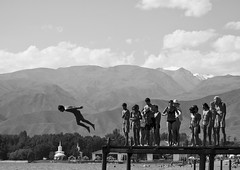
In the Republic of Kyrgyzstan, the northern Tian Shan mountains, Issyk Kul is an endorheic saline water lake that was supposed to be an ancient metropolis, 2,500 years ago. The average water depth is 1,000 feet while the deepest point goes down to 2,192 feet.
According to the legend, during pre-Islamic times, the king of the Ossounes had donkey’s ears. He managed to hide them however, by killing all his barbers to make sure the secret wouldn’t leak out, yet one day, one of the barbers escaped and yelled the secret into a well and left it uncovered, which caused water to rise and flood the kingdom.

Image by 1, 2, 3, 4, 5
It would be interesting to explore the truths behind this story, as archaeological finds indicated the presence of an advanced ancient civilization where the the Issyk Kul lake is currently located.
6. Lake Malawi

Images by 1, 2, 3, 4, 5
Also known as Lake Nyasa, Lake Malawi is the most southern lake in the East African Rift valley system, located between Malawi, Mozambique, and Tanzania. At 2,316 feet deep, it’s the second deepest lake in Africa and thanks to the tropical waters it has more fish species than any other lake on Earth.
Researchers have studied sediments from core samples of Lake Malawi, which revealed that 100,000 years ago, water levels dropped to about 2,000 feet, turning the land around the lake into semi-desert and arid scrubland habitat. According to some, this may be why early man fled from Africa to colonize other parts of the world.
5. O’Higgins/San Martín Lake

Images by 1, 2, 3, 4, 5, 6
Located in Patagonia, between the Aysén Region and the Santa Cruz Province, the lake is called O’Higgins in Chile and San Martin in Argentina. It is the deepest lake in the Americas with a maximum depth of 2,742 feet (measured near the O’Higgins Glacier). The lake is very irregular consisting of eight well-defined arms with milky light-blue water coming from the suspended rock flour.
The lake is named after South American heroes José de San Martín of Argentina and Bernardo O’Higgins of Chile, who fought together for the liberation of Chile.
4. Lake Vostok

Images by 1
Out of the 140 sub-glacial lakes on earth, Vostok is the largest and the deepest, with a maximum depth of 2,950 feet. Beneath Russia’s Vostok Station, 13,000 feet under the surface of the central Antarctic ice sheet, may be the most unspoiled lake on Earth. British and Russian scientists only discovered it in 1996.
The average water temperature is -3 °C and the reason why it is still liquid below freezing is the high pressure from the weight of the ice above it.

Images by 1
Scientists also discovered that the ice core may be 420,000 years old, meaning that the lake could have been sealed for over 500,000 years and the water beneath could be doubly as old.
So far there isn’t any proof of life in LakeVostok. Notwithstanding this, in case there are species living beneath the murky depths, they are most likely to have evolved special features in order to survive the lake’s oxygen-rich environment.3. Caspian Sea

Image by 1, 2, 3, 4
Between the southern areas of the Russian Federation and northern Iran, lies the largest enclosed body of water on Earth. It’s an endorheic lake with salty water (salinity of approximately 1.2%) that was landlocked due to continental drift 5.5 million years ago. An ancient remnant of the Tethys Ocean, (just like the Black Sea or the Mediterranean Sea) it is the third deepest lake in the world going down to 3,363 feet.
Fauna in the Caspian basin is very rich: great numbers of sturgeon (that’s where you get the great caviar), the Caspian seal and some fish endemic to the Caspian Sea like the Kkturn (Caspian white fish), Caspian roach, Caspian bream and an array of rare species of salmon only to be found in that area.
The Caspian Sea is very rich in energy resources like oil and gas deposits, which have been tapped since the 10th century. These days, the oil in the Caspian basin is supposed to be worth $12 trillion.
2. Tanganyika Lake

Image by 1
Divided between
Burundi, the
Democratic Republic of the Congo (45%),
Tanzania (41%) and
Zambia,
Tanganyika is the deepest fresh water lake in
Africa and the second in the world with a maximum depth of
4,823 feet. The lake was “mistakenly” discovered in 1858 by two British explorers, Richard Burton and John Speke, in their quest to find the
Nile’s source.

mage by
1 A recent story on National Georgraphic talks about a cold-blooded serial killer on the shores of Lake Tanganyika. Called Gustave, it was a 20 feet long crocodile that weighted 2,000 pounds and was responsible for killing hundreds of people.
1. Lake Baikal

Image by 1, 2, 3, 4, 5
Also known as the “blue eye of Siberia”, lake Baikal is located in Southern Siberia near R near the Russo-Mongolian border. Famous for being the deepest lake in the world with a maximum depth of 5,369 feet it holds a volume of water larger than that of all the great lakes combined.
Lake Baikal is a great eco-system where more than 1,700 species of flora and fauna live; two thirds of them only to be found here. Completely surrounded by steep mountains and dense forests, the lake has an estimated age of 25-30 million years, making it one of the most ancient lakes in geological history.
However, this enormous water formation may harbor a mystery of immense proportions: a gigantic animal, either of sturgeon-like appearance or a rogue sea serpent; Baikal’s very own Loch Ness Monster. No one can tell for sure if the legend is true or not, but the creature exists in people’s minds and haunts their thoughts.
If you know of any other deep lakes worth exploring, please drop us a line in the comments.
Original here
 Image via Flickr User Sniggity
 Image by 1 With a violent volcanic past, the caldera lake in the Crater Lake National Park, Oregon, is a place of immeasurable beauty. Surrounding cliffs of up to two thousand feet high, two small islands and spectacular blue water, make this “outdoor laboratory” the perfect place for photographers.
 mages by 1, 2, 3, 4


 mage by 1


 Imagine getting up in the morning, collecting the garbage in your home, and taking it outside. After opening your door, you see a person watching you intently from the corner of your street. You walk a few steps, and place your trash bags where they will eventually be picked up. No sooner than you turn your back, that eager person from the corner is making their way over to your refuse. Within moments they are rummaging through the waste. Searching for bottles and other items of value, you might occasionally see them kicking toward hungry street dogs to protect their bounty and themselves from a painful bite. While this scenario might seem ridiculous to you, it happens every day in Peru. The circumstances for why people in Peru collect re-usable and recyclable items in the trash is complex, intriguing, troublesome, and potentially wonderful.


 Posts
Posts