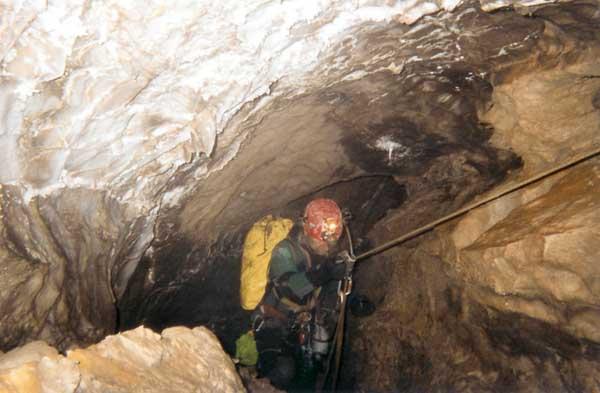
Image via Brian Masney
 Long ago, our ancestors were using caves as shelter from wild animals and the forces of nature. Perhaps, this base necessity however, has always been eclipsed by man’s curiosity and desire to explore the mystical and enigmatic air inside the abyss. In the past, Environmental Graffiti has explored some amazing uses of caves – from discotheques, temples and underground cities to hotels and primary schools. That’s only scratching at the surface however. Today, with all sorts of equipment, caving has turned into something of an extreme sport - it involves climbing, crawling and sometimes even swimming. Looking at the most extreme end then, what about those caves that create the enigma, that fuel the stuff of legends; caves that appear bottomless and that seem to extend to the very center of the earth? What are the ten deepest caves on our planet?
10. Cehi 2
Slovenia’s deepest cave was mapped by Italian explorers from the Club Alpino Italiano of Trieste. They published a very interesting document, called Progressione 50: although it’s in Italian, you can see how the expedition went inside the Cehi 2 (or Ceki 2). The cave, which is in the Canin Massif, is located in the Western Julian Alps, on the Italian-Slovenian border. The alpinists managed to go as deep as 4928 feet (1502 m). To put this in perspective, the depth is over twice the height of the tallest man-made structure in the world.

9. Sima de la Cornisa - Torca Magali
This is a caving system in the Picos de Europa mountains in Spain. An international team of speleologists including Valencian Silvino Villa and the Belgian Jan Masschelein explored the cave last summer and managed to go down, in what they call a “bottomless pit”, to 4944 feet (1507 m).

8. Shakta Vjacheslav Pantjukhina
As you notice from the next few items on the list, the Bzybsky Massif in Georgia is renowned and very rich in caves. More than 400 are present and just one of them that made it to our list of the deepest caves in the world is the Shakta Vjacheslav Pantjukhina. It’s 4948 feet (1508) m deep.

7. Sarma
The seventh deepest cave in the world is in the Caucuses range, in Abkhazia, Georgia and it goes down up to 5062 feet (1543 m). Speleologists that attended the expeditions from December 18, 2007 to January 12, 2008, mentioned that Sarma has the biggest potential to surpass Voronja and break the world record for being the deepest cave. They are still exploring the interior of this unfathomable enigma.

6. Torca del Cerro del Cuevon also known as T-33 and La Torca de las Saxifragas
Together, these two form the deepest cave in Spain. Located in the Picos de Europa mountains in the northern coast of the country, there are very few entrances to the cave, thus rendering it incredibly difficult to explore, so much so, that is considered to be the most technically difficult in the world. It took explorers 3 days to go to 5213 feet (1589 m) down.

5. Reseau Jean Bernard
Also known as the Gouffre Jean-Bernard or simply Jean Bernard, this is a 5256 feet (1602m) deep cave in the French Alps, in Samoëns. The cave has at least 8 entrances and was first discovered by the Groupe Vulcain back in 1959. Until 1980, it was considered to be the deepest cave in the world. Despite this, professional cavers consider the Jean Bernard not very interesting to climb.

4. Vogelshacht and Lamprechtsofen
A Polish Expedition (pdf link) connected the two caves: Vogelshacht and Lamprechtsofen, located in the Leoganger Steinberger area, in Salzburg, Austria. The cave system has so far been proven to be 5354 feet (1632 m) deep. Incredible really, that’s over a mile. Notwithstanding this, explorations continue, so this could be only the tip of the iceberg.

3. Gouffre Mirolda
From 9 to 12 January in 2003, an expedition exploring the Gouffre Mirolda cave in France, found that it was connected with the Lucien Coudlier, breaking the record for the world’s deepest cave . The cave measured 5685 feet (1733m) while the world record at the time was 5610 feet (Voronja cave). It was the first cave to be explored below 1 km. The record however, was beaten within a matter of years.

2. Illuzia-Snezhnaja-Mezhonnogo
Two times larger than the world’s deepest cave, the Illuzia-Snezhnaja-Mezhonnogo cave is the second deepest in the world. Located on the Bzyb massif in Abkhazia, Georgia, the cave is renowned for being dangerous and very difficult to work in.

A team lead led by Aleksey Shelepin, in July 2007, came out with a very spectacular discovery giving birth to the cave system Illuzia-Sneznaja-Mezonnogo. Apparently there are two caves, Illuzia (Illusion) and Sneznaja (Snowy), that connect together and go down 5,751 feet (1,753 meters).
1. Krubera-Voronja Cave
Also known as the Cave of Kruber, Voronja is the deepest cave in the world with recent measurements extending to a total depth of 7188 feet (2191 m). It was the first cave to be explored to a depth of more than 2 km down.

Images via 1, 2, 3
On August 5th 2007, an international expedition with 56 members went in and the interesting thing is, they said that the cave system could be deeper. “The caving game is far from over. It won’t be; not as long as deeper abysses call out to be explored” said Alexander Klimchouk, a renowned speleologist.
The Crows’ Cave (that what it means) is located in Georgia in the Arabika Massif of the Gagra Range, near the coast of the Black Sea.


 Posts
Posts