Followers

Thursday, September 11, 2008

NASA's options for space program dwindling

By Irene Klotz

NASA is about out of options for keeping U.S. astronauts in space after 2011.

Unless President George Bush intervenes, or whoever succeeds him in January immediately steps into the space arena, the dismantling of the space shuttle program will be too far along to reverse course.

"That horse has left the barn," wrote NASA's former shuttle manager Wayne Hale in his Web blog.

The three-ship fleet is scheduled for retirement in 2010. NASA wants to use the shuttle's budget for developing replacement ships that can go to the moon as well as to the International Space Station. The new vehicle, called Orion, won't be ready until 2015 — five years after the shuttle stops flying.

NASA had counted on buying Russian Soyuz capsules to transport crews to the space station during the gap. But in recent interviews, NASA administrator Michael Griffin said he has no hope Congress will pass the legislation needed for NASA to keep the Soyuz assembly lines running.

"My guess is that there is going to be a lengthy period with no U.S. crew on (the space station) after 2011," Griffin wrote in an e-mail to top NASA managers that was posted on the Orlando Sentinel's Web site.

The agency cannot purchase Russian rockets unless it receives an exemption from a trade sanction Congress levied in 2005 after Russia reportedly helped Iran develop nuclear weapons technology. Griffin has said the exemption to the Iran, North Korea and Syria Nonproliferation Act needs to be in place by early 2009 to keep U.S. and partner astronauts in orbit.

U.S. outrage over Russia's handling of a dispute with neighboring Georgia has pretty much nixed any chance Congress will lift the trade ban again, Griffin said.

"Exactly as I predicted, events have unfolded in a way that makes it clear how unwise it was for the U.S. to adopt a policy of deliberate dependence upon another power for access to ISS," Griffin wrote.

"In a rational world, we would have been allowed to pick a shuttle retirement date to be consistent with Ares/Orion availability … and we would have been provided the necessary budget to make it so.

"The rational approach didn't happen, primarily because for OSTP (Office of Science and Technology Policy) and OMB (Office of Management and Budget) retiring the Shuttle is a jihad rather than an engineering and program management decision," Griffin wrote.

Despite the dire forecast, NASA's associate administrator for space operations Bill Gernstenmaier said there was still time to work out a solution. For now, the shuttle program's top priority needs to be next month's mission to upgrade the Hubble Space Telescope.

"We need to step back from the hum of the outside world and focus on this Hubble mission," Gerstenmaier said.

Original here

Maximizing Survival Time Inside the Event Horizon of a Black Hole

Written by Fraser Cain

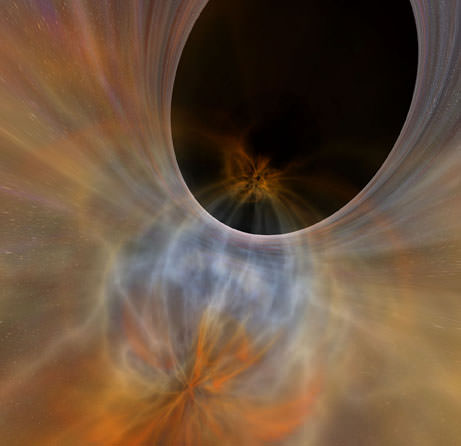
DonHere's a scenario that will face many of us in the far future. You're hurtling through the cosmos at nearly the speed of light in your spaceship when you take a wrong turn and pass into the event horizon of a black hole. Uh oh, you're dead - not yet, but it's inevitable. Since nothing, not even light can escape the pull from a black hole once it passes into the event horizon, what can you do to maximize your existence before you join the singularity as a smear of particles?

Physicists used to think that black holes were sort of like quicksand in this situation. Once you cross the event horizon, or Schwarzschild radius, your date with the singularity is certain. It will occur at some point in the future, in a finite amount of proper time. The more you try to struggle, the faster your demise will come. It was thought that your best strategy was to do nothing at all and just freefall to your doom.

Fortunately, Geraint F. Lewis and Juliana Kwan from the School of Physics at the University of Sydney, have got some suggestions that fly in the face of this stuggle = quick death hypothesis. Their paper is called No Way Back: Maximizing survival time below the Schwarzschild event horizon, and it was recently accepted for publication in the Proceedings of the Astronomical Society of Australia.

When an unlucky victim falls into the event horizon of a black hole, they will survive for a finite amount of time. If you fall straight down into a stellar black hole, you'll last a fraction of a second. For a supermassive black hole, you might last a few hours.

Due to the tremendous tidal forces, an unlucky victim will suffer spaghettification, where differences in gravity from your head to your feet stretch you out. But let's not worry about that for now. You're trying to maximize survival time.

Since you've got a spaceship capable of zipping around from star to star, you've got a powerful engine, capable of affecting your rate of descent. Point down towards the singularity and you'll fall faster, point away and you'll fall more slowly. Keep in mind that you're inside a black hole, flying a spaceship capable of traveling near the speed of light, so Einstein's theories of relativity come into play.

And it's how you use your acceleration that defines how much personal time you'll have left.

In a moment of panic, you may point your rocket outwards and fire it at full thrust, keeping the engine running until you arrive at the central singularity. However, Lewis and Kwan have demonstrated that in the convoluted space-time within the event horizon, such a strategy actually hastens your demise, and you'll actually end up experiencing less time overall. So, what are you to do? Lewis and Kwan have the solution, identifying an acceleration "sweet-spot" that gives you the maximal survival time. All you have to do, once across the event horizon, is fire your rocket for a fixed amount of time, and then turn it off and enjoy the rest of the fall.

But how long should you fire your rocket for? Lewis and Kwan show this is a simple calculation involving the mass of the black hole, how powerful your rocket is, and how fast you crossed the event horizon, easily doable on a desktop computer.

Here's another analogy from Lewis:

"Consider a race to the centre between a free faller and a rocketeer. Suppose they cross the event horizon together holding hands. As they cross, they start identical stop watches. One falls inwards, while the other accelerates towards the centre for a little, then swings their rocket round and decelerates such that the free faller and the rocketeer meet and clasp hands again just before hitting the singularity. A check on their stop watches would reveal that the free faller would experience the most personal time in the trip. This is related to one of the basic results of relativity - people in freefall experience the maximum proper time."

So now you know. Even after you've fallen into the black hole's event horizon, there are things you can do to lengthen your harrowing journey so that you get to experience more time.

Time to you can use to deal with your spaghettification problem.

Original here

The Future: Open-Source Humanoids

Mayjune06robots2_2 Mega-monolithic corporations are often be seen as the bad guys, creating faceless hordes and irresponsibly-armed technologies, but the end of humanity might come from the little guys. Humanoid robot design has gone open source - so don't be surprised if your silicon killer lasers "HAxxor3D by StumpyJO!" into your corpse.

The Willow Project is a seriously cool effort to bring robotics to the masses: think of it as Lego Mindstorms all grown up. The project makes all their hardware and software designs open source, so anybody with the capability can take part, downloading existing designs and uploading their own. You don't have to be Dr Robotnik taking a break, either - the project includes tutorials and instruction, so all you need is the desire to make awesome robots.

And if you don't have that we don't know why you're reading here.

Open sourcing robotics clears the way for all kinds of incredible innovations. Some developments might not have the security or stability of commercial releases, but you don't have to wait for a million people to want something before it becomes profitable. The internet has already shown that sheer love and hard work can create the most amazing things, and now that same creative energy can be directed into things that can then get up and walk.

As robotics technology evolves the homebrew programs will accelerate to keep pace: don't be surprised to find "flesh{bot 0.1" available for bittorrent in the next ten years. With advances in synthetic skins, certain sectors of the web might be able to download entire behaviour sets instead of just movies of people doing those things. As long as they watch out for security. It's bad enough when your computer can steal your bank account info - but when a robot can physically go through your wallet, the best firewall in the world won't save you.

Original here